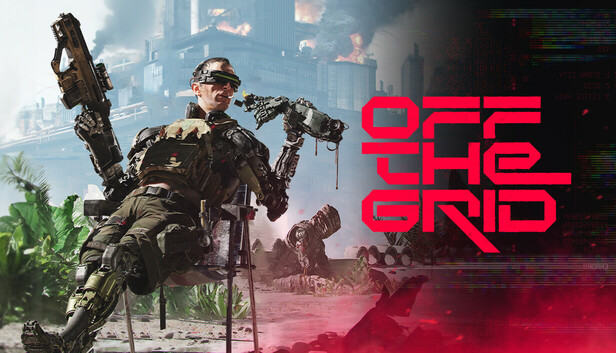
Overview:
- Genre: Battle Royale
- Platform(s): PC, Playstation 5 and XBOX Series X/S
- Role: Principal Level Designer
- Release Date: July 17th, 2025
Set in a cyberpunk dystopia, players fight on a fictional island named ‘Teardrop Island’ as participants in a mysterious competition using high-tech cybernetic prosthetics and futuristic military weapons and equipment. Players can find data cubes (HEXes), extract them during matches and equip or sell their contents afterwards. The game is played from a third-person perspective and developed in Unreal Engine 5.
Responsibilities:
- Multiplayer Layouts: What makes a fun PvE gameplay space in this game and how does it fit into the bigger layout of the map? I designed layouts for major locations on the Battle Royale map, created POIs for players and fleshed out ‘buffer zones’ (the connecting tissue between main locations). Zooming out further, I also planned out and whiteboxed the entire Western third of the BR map that is currently still unreleased/under NDA.
- World Building: What story does your world tell and does it make sense to the player? Collaborating closely with Narrative and Art departments I took the geology and history of the island in addition to real-life examples into account to create a believable, coherent world.
- Full-Cycle Development: From location research, diagrams, whiteboxes, playtests, iterations and bug fixing to release and beyond – I’ve gone through each development phase on this project.
- Collaboration & Leadership: As a Design Owner I lead pods of Level Designers to work on major locations. I collaborated with stakeholders and other departments to make sure everyone was aligned. I took over Interim-Lead responsibilities for the team until a new Team Lead was found.
- Mission Spaces: What happens when we throw Enemy AI into the mix and how do we make sure it is going to be fun? I was involved in the prototyping and development of custom spaces intended for PvEvP missions.
- Optimizations: Fast framerates are priority #1. I did sweeps of asset reductions and (re-)packaging for performance optimization without negatively affecting gameplay.
- Prototyping: I ceated an entirely new map for a prototype game mode that is still unreleased/under NDA.
Locations:
‘Saltie’
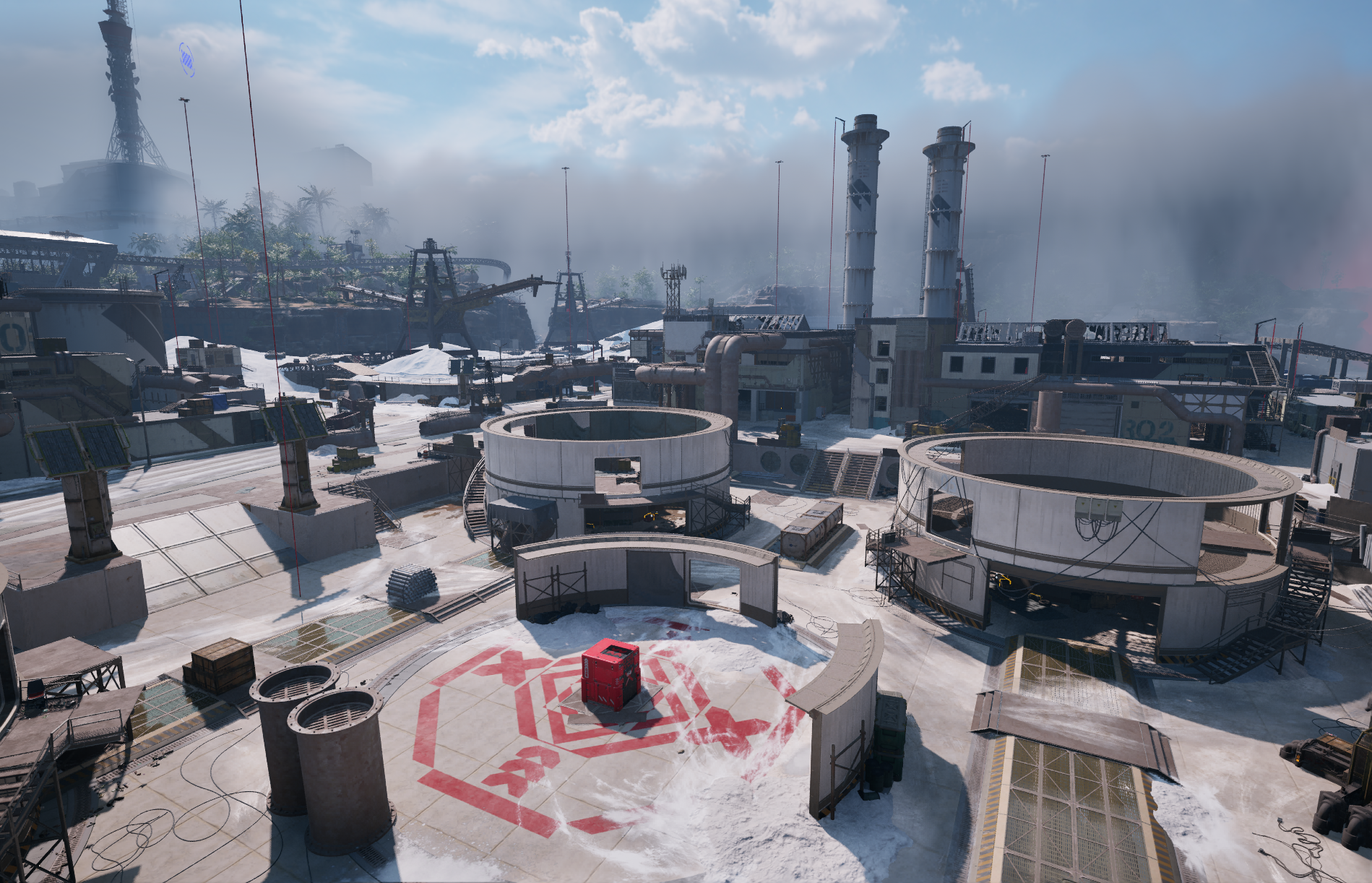
Typical for the Battle Royale genre, the game is taking place on a large map made up several key locations (and the ‘skin issue’ in-between). One of these locations is an abandoned desalination plant on the coast of the island. It is made up of cylindrical clarifying pools, silos, industrial buildings, worker accomodations and giant salt piles.
Pre-Production: When I joined the team, the research for the location was already done. We knew how a desalination plant works in real-life and thanks to the style of the game we were making (futuristic dystopian cyberpunk grounded in realism) we could take some liberties. A narrative background to the location, a list of buildings and key concept art existed, an early whitebox was already in development.
Camera: Early playtests uncovered some issues: Pipes were a logicial element of this location, but I had to let go of the idea that players could get inside them. It appeared like a promising, novel idea, but, even with a lot of exit points on each accessible pipe, it isn’t fun to be bumping your camera against the inner shell of a pipe in a 3rd person game and having your fast movement mechanics be so constrained while inside. It was still important to me to subtly show the desalination process by showing the flow of the water/pipes through the areas, but the pipes remained inaccessible and were always covered by grates to prevent movement issues for the player character.
Movement: Any prop that would impede the fast character movements that players can do in OTG or unnecessarily block sightlines was removed. It showed that the context of the game that you are designing in is key. If this was a slow-paced Cover Shooter, I could have/should have never done that. But since players are equipped with supersprint cyberlimbs and jetpacks, the concern about player movement was much greater than about cover from snipers. But less cover doesn’t mean ‘no cover at all’. This gave us some interesting challenges during the design of the giant salt piles. Naturally, any type of foliage on the salt was out of the question. Reference images didn’t show many objects on such piles, in general. We arrived at a mix of trenches between the piles, big conveyor belt towers (bonus points for verticality!) and vehicles scattered across the piles to fix this problem.
Whitebox:
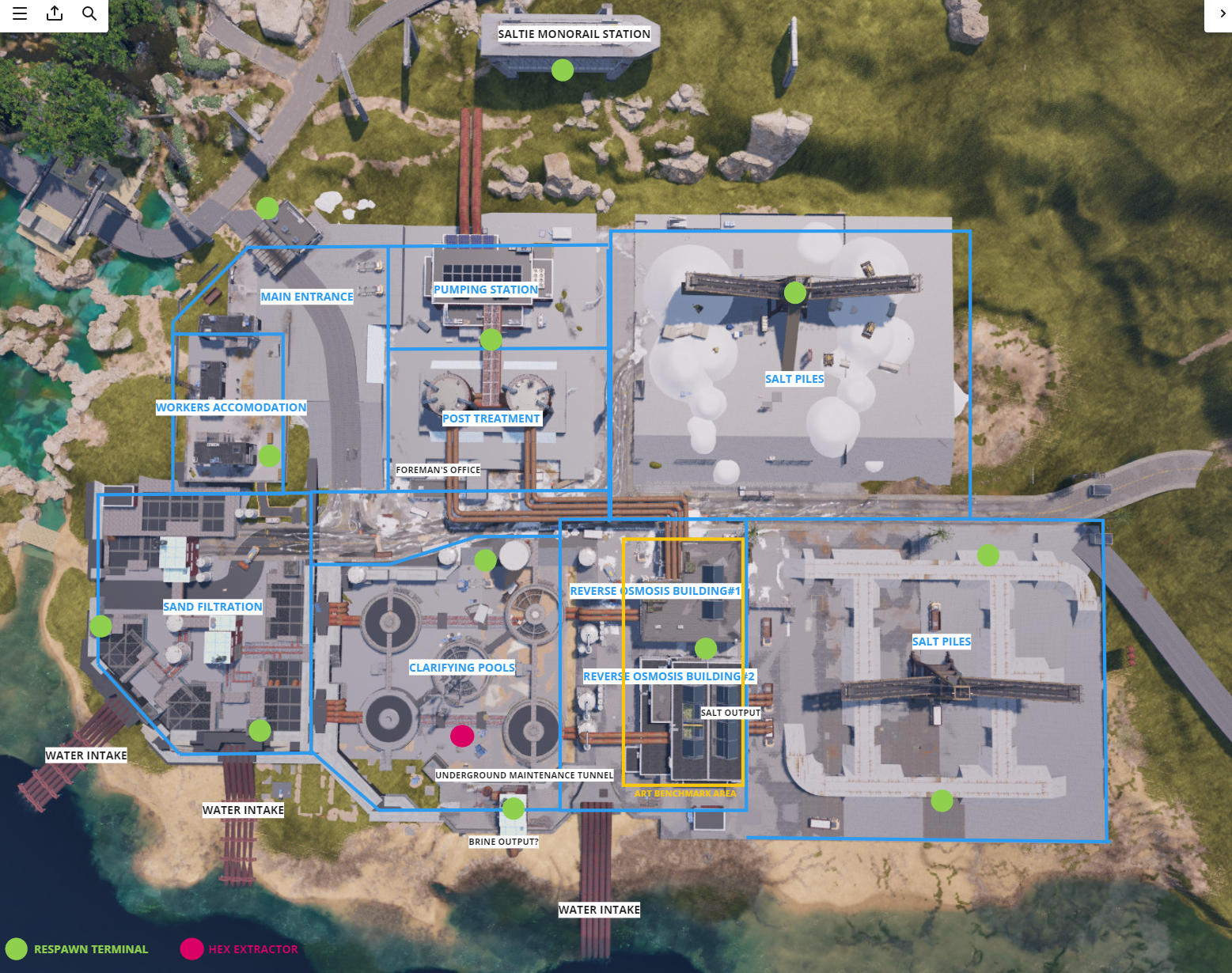
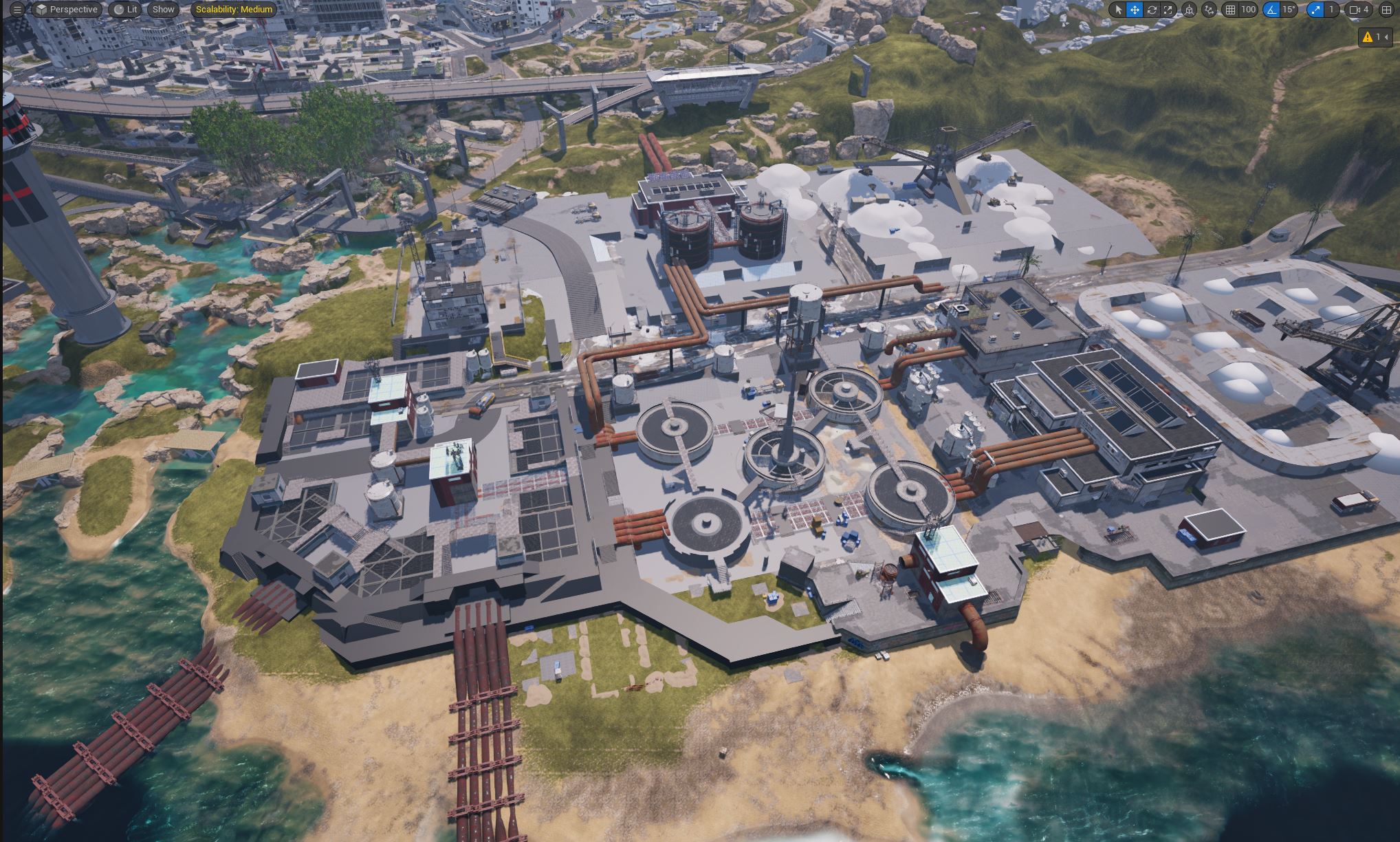
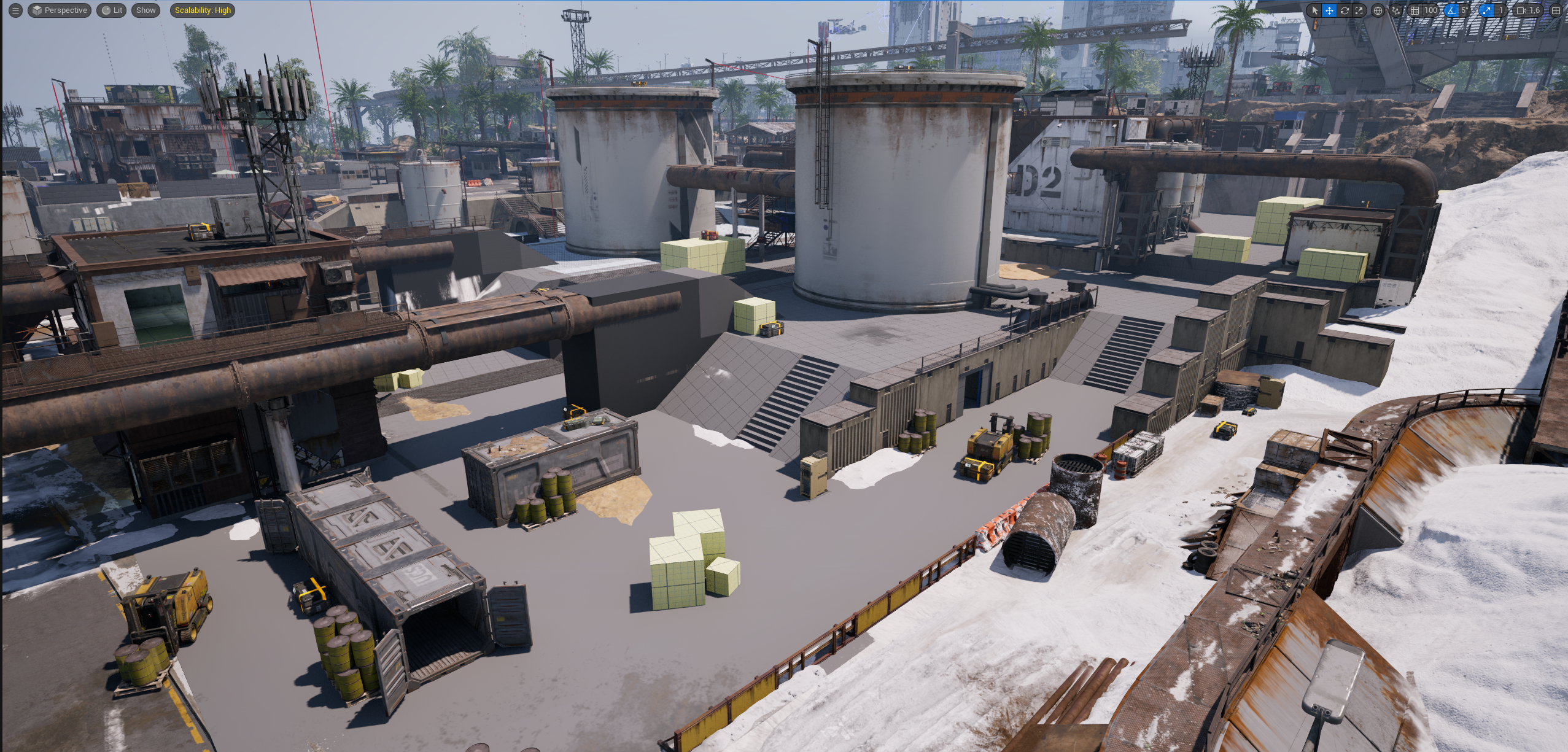
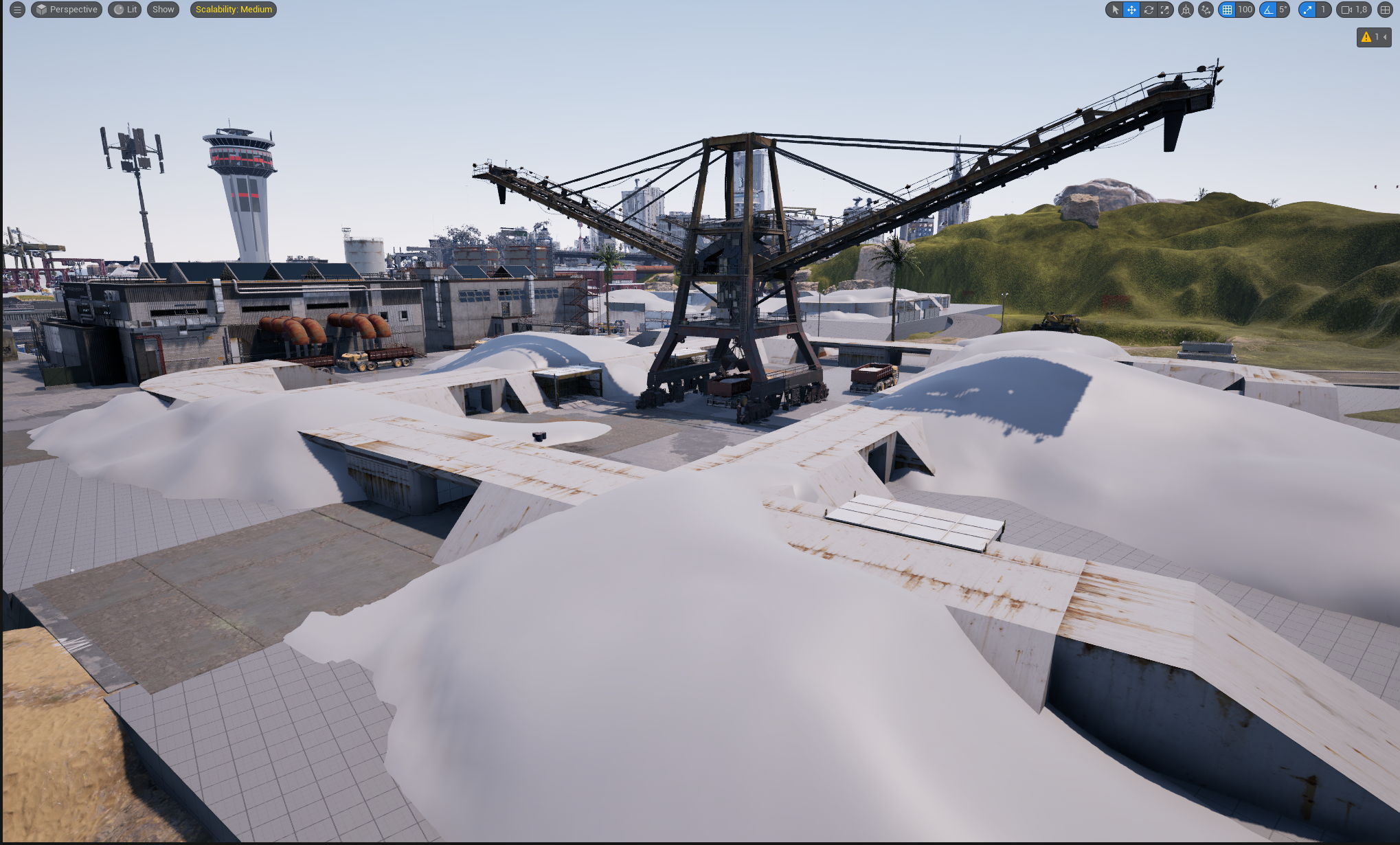
Layout: I also had to reduce the long shopping list of buildings and reduce Saltie’s size. Areas/buildings that weren’t fun (e.g. the roofs of large water reservoirs) or would take Art too long to build were cut. The assets for the most unique aspect of the location – the salt piles – were re-used and that area expanded. Buildings were moved so they made sense from a world building and gameplay perspective. For example, the workers accomodation used to by the shoreline, but they make more sense to be by the main entrace from a logistics point-of-view. They also serve as a nice point-of-entry for players coming in from the West who want to scout the location from the inside and/or loot first.
Metrics & Collisions: Any building facades and prop arrangements that were off-metric, required too many chained climbs/mantles or had problematic collisions I fixed or worked together with Env Art to get addressed. Same for too narrow spaces or objects clipping with the player character’s view.
Finishing Touches: Not surprisingly, it took many playtests and iterations to arrive at the final locations of loot spawns, respawn terminals, missions starters and ziplines. Any static object that wasn’t already inside a packaged level actor had to be packed for performance optimization and bugs got fixed as many as we could find.
Final Art:
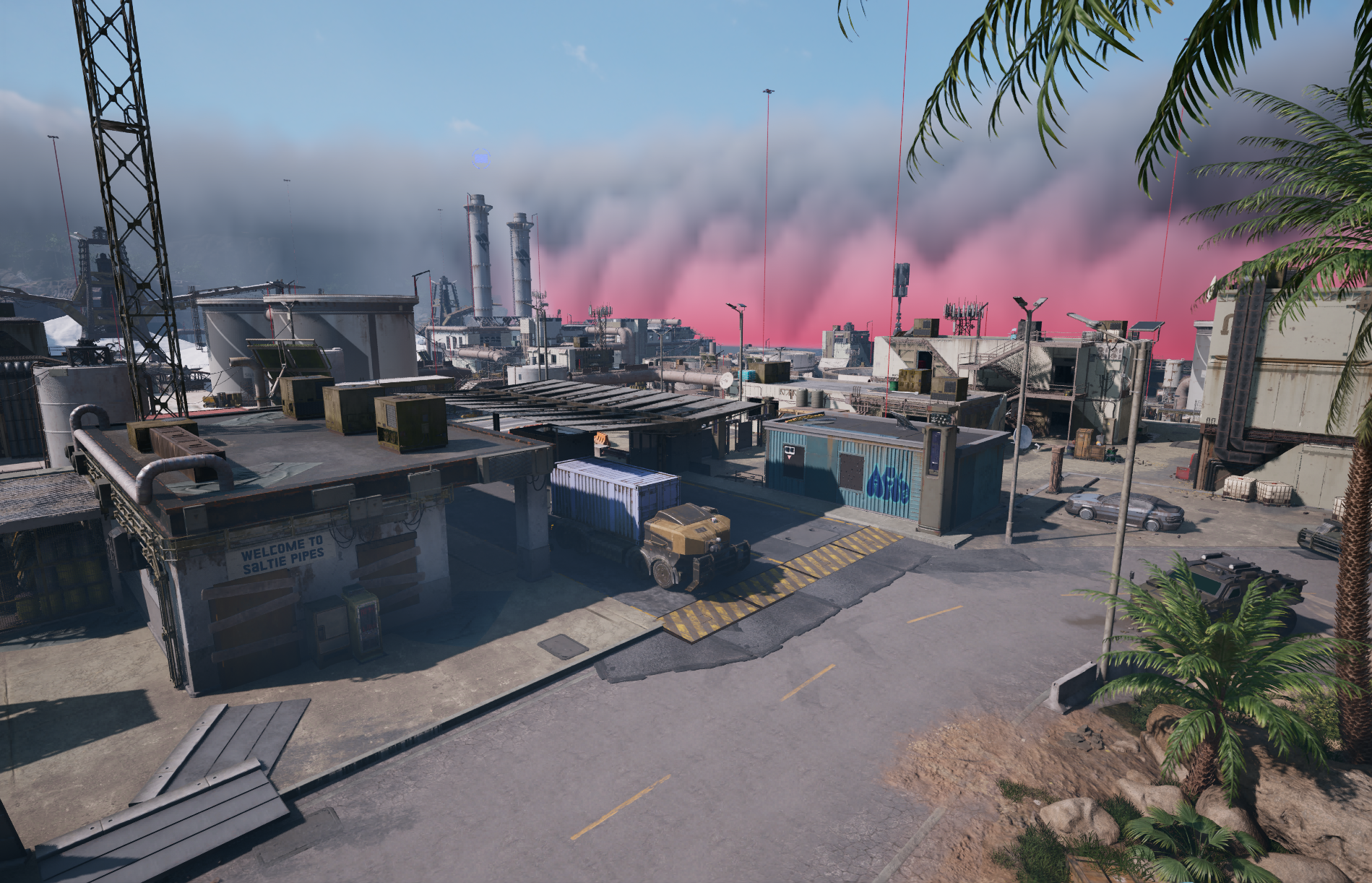
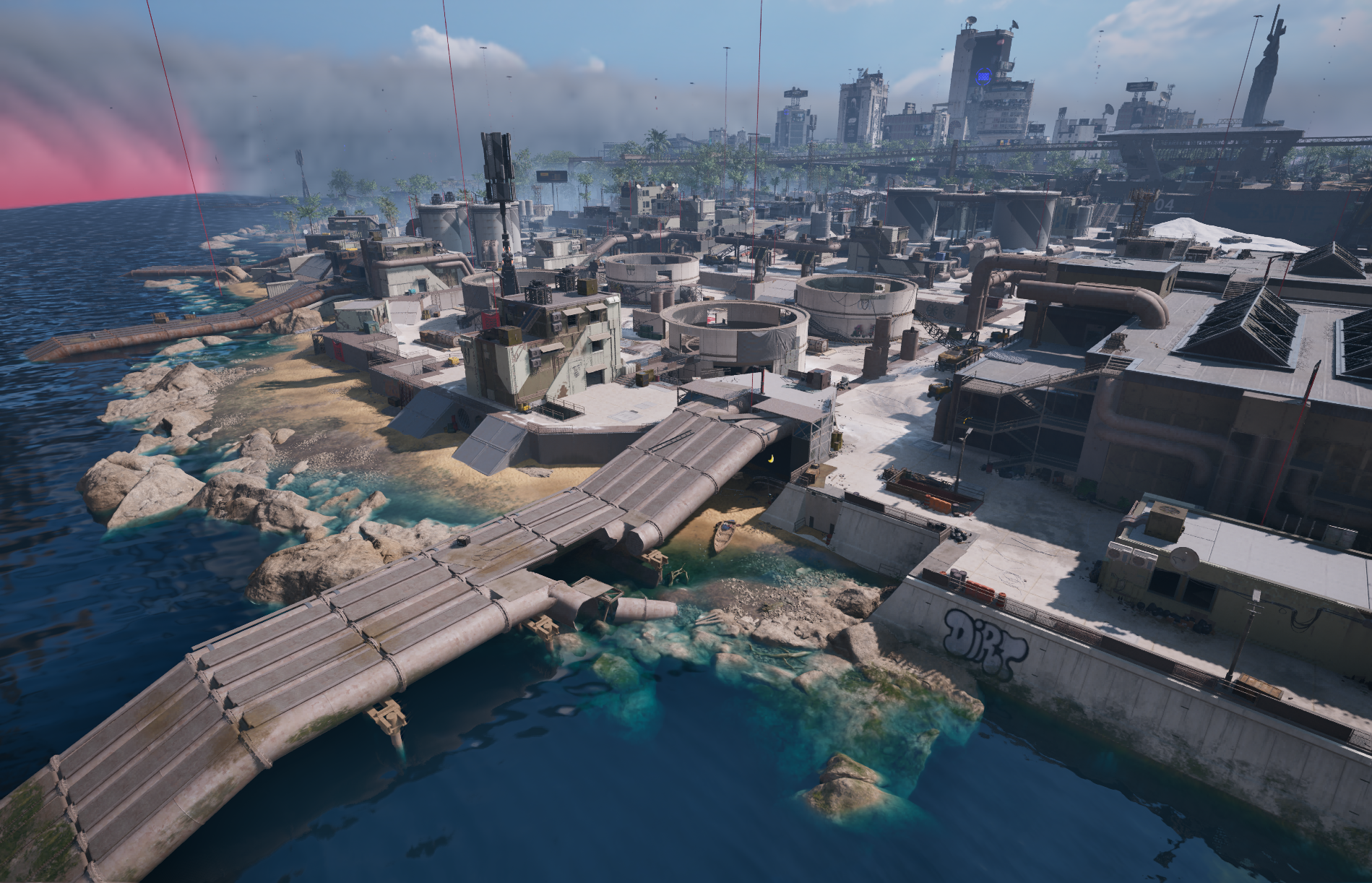
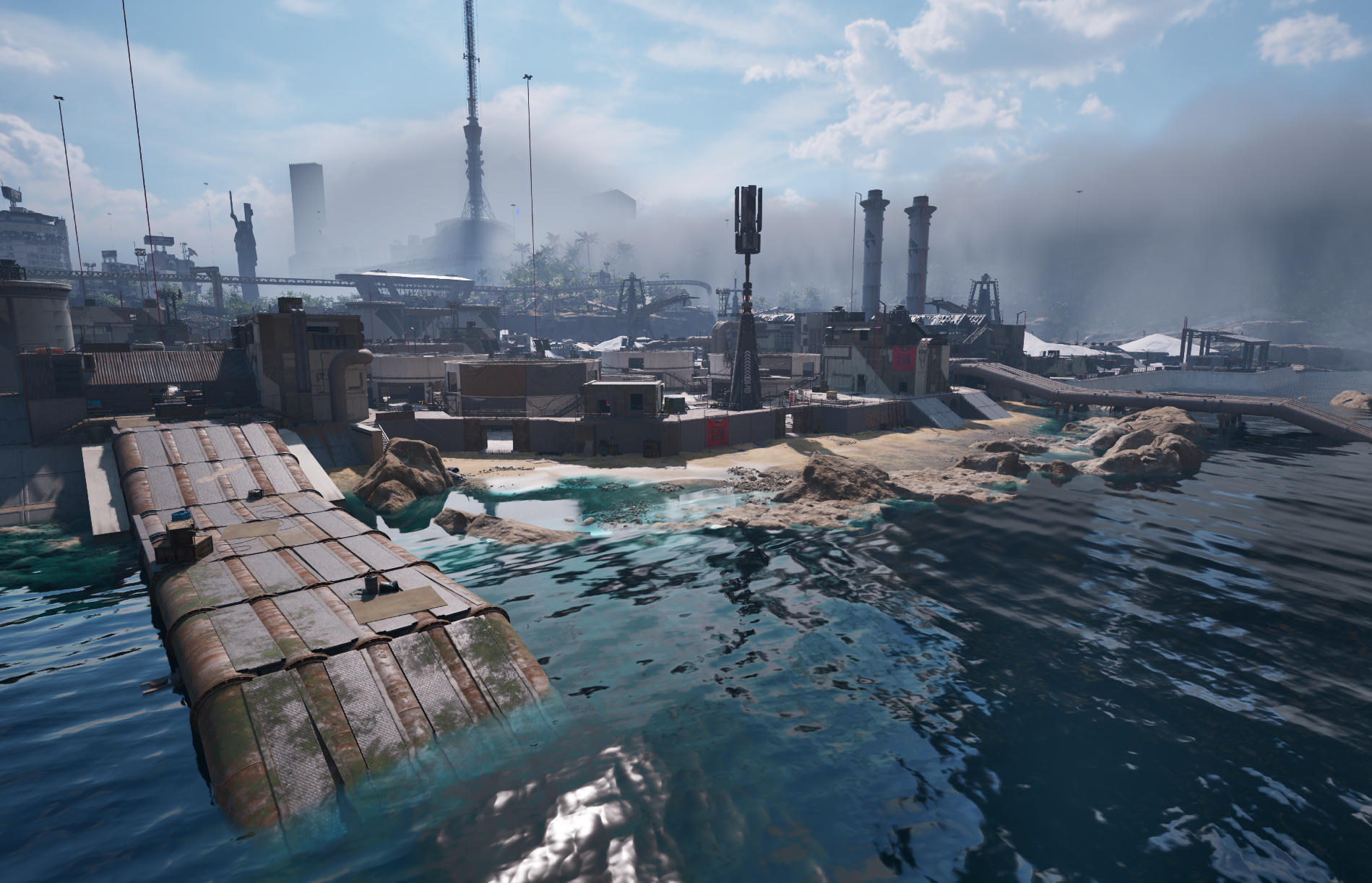
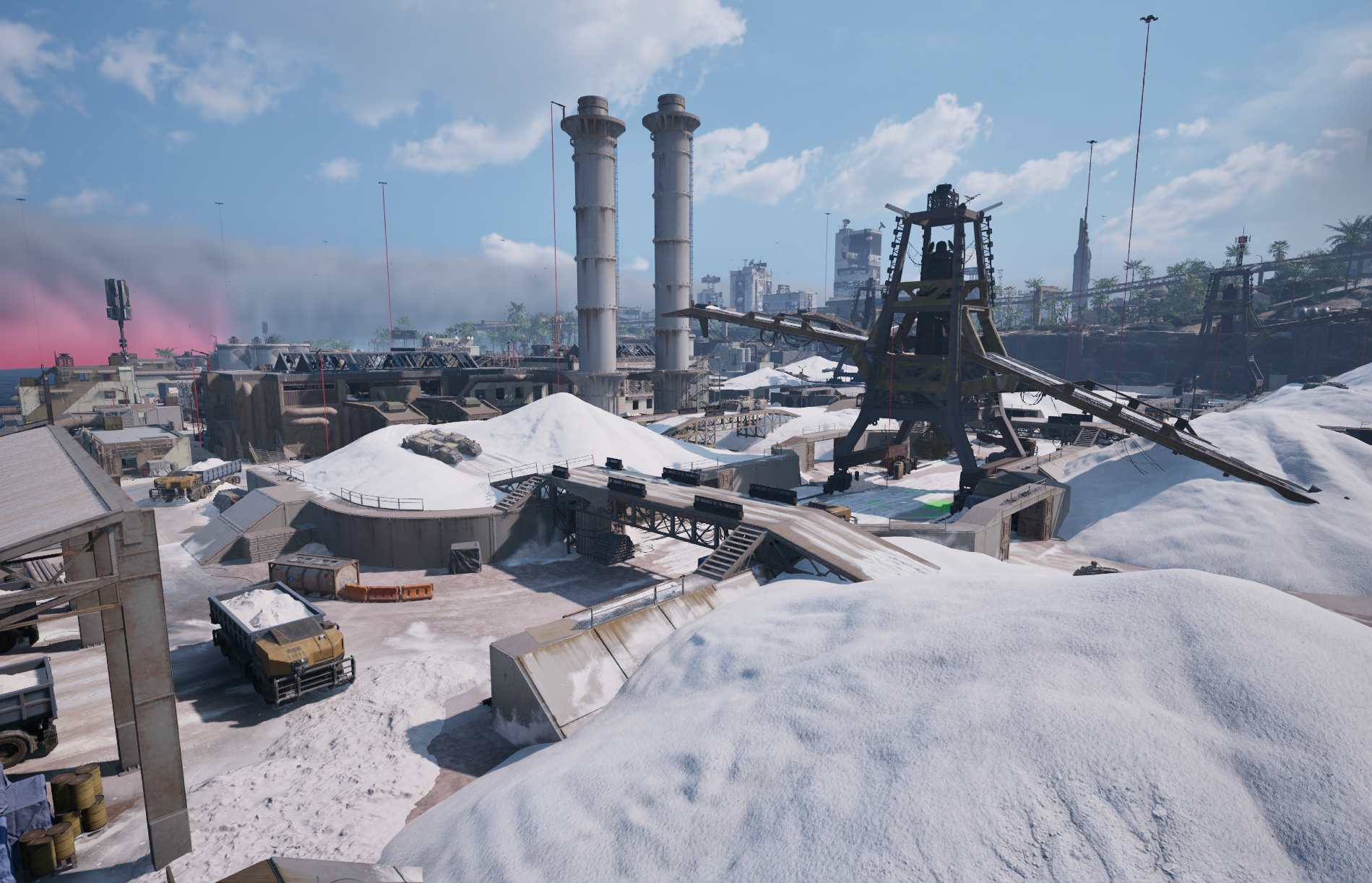
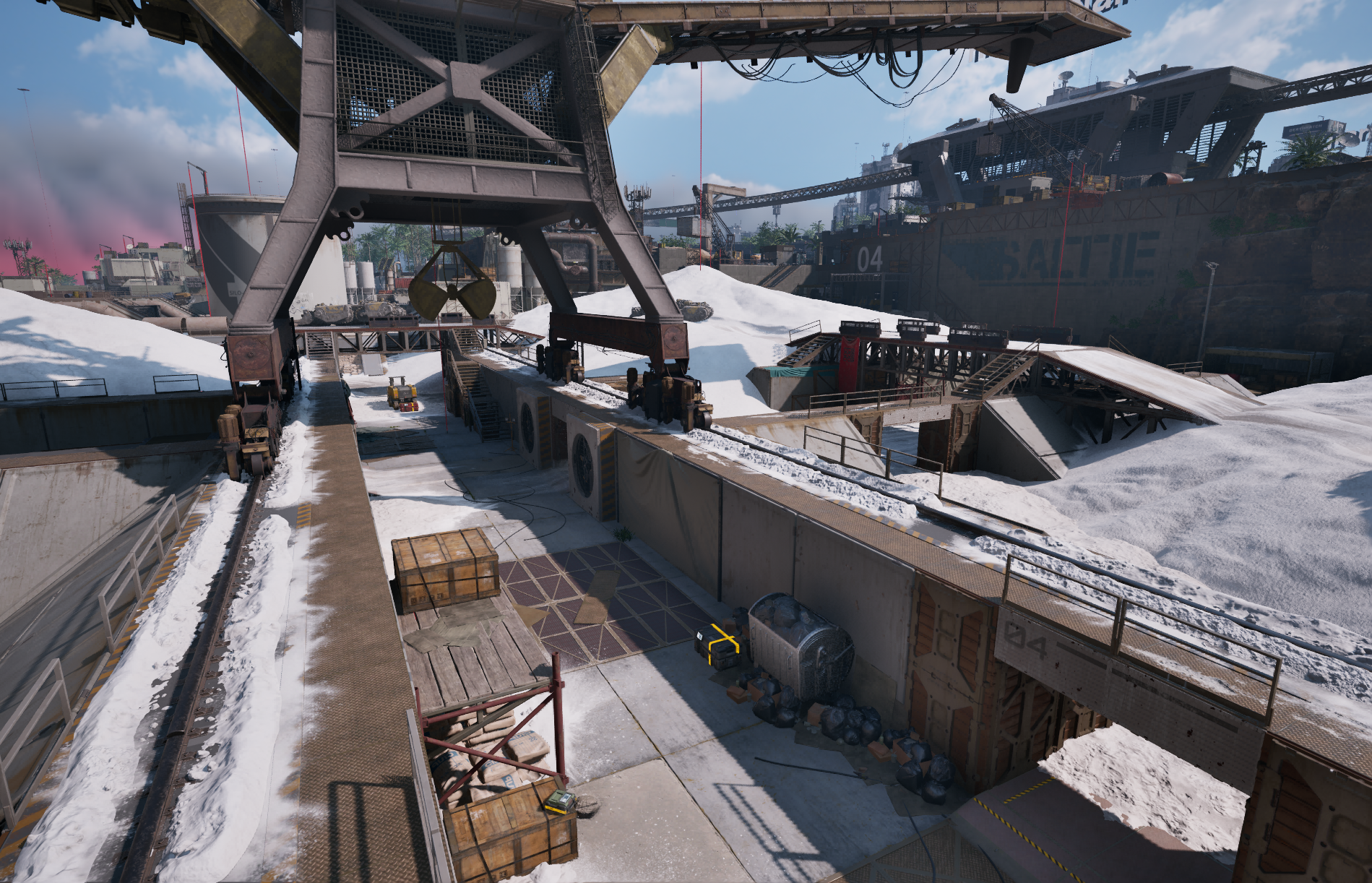
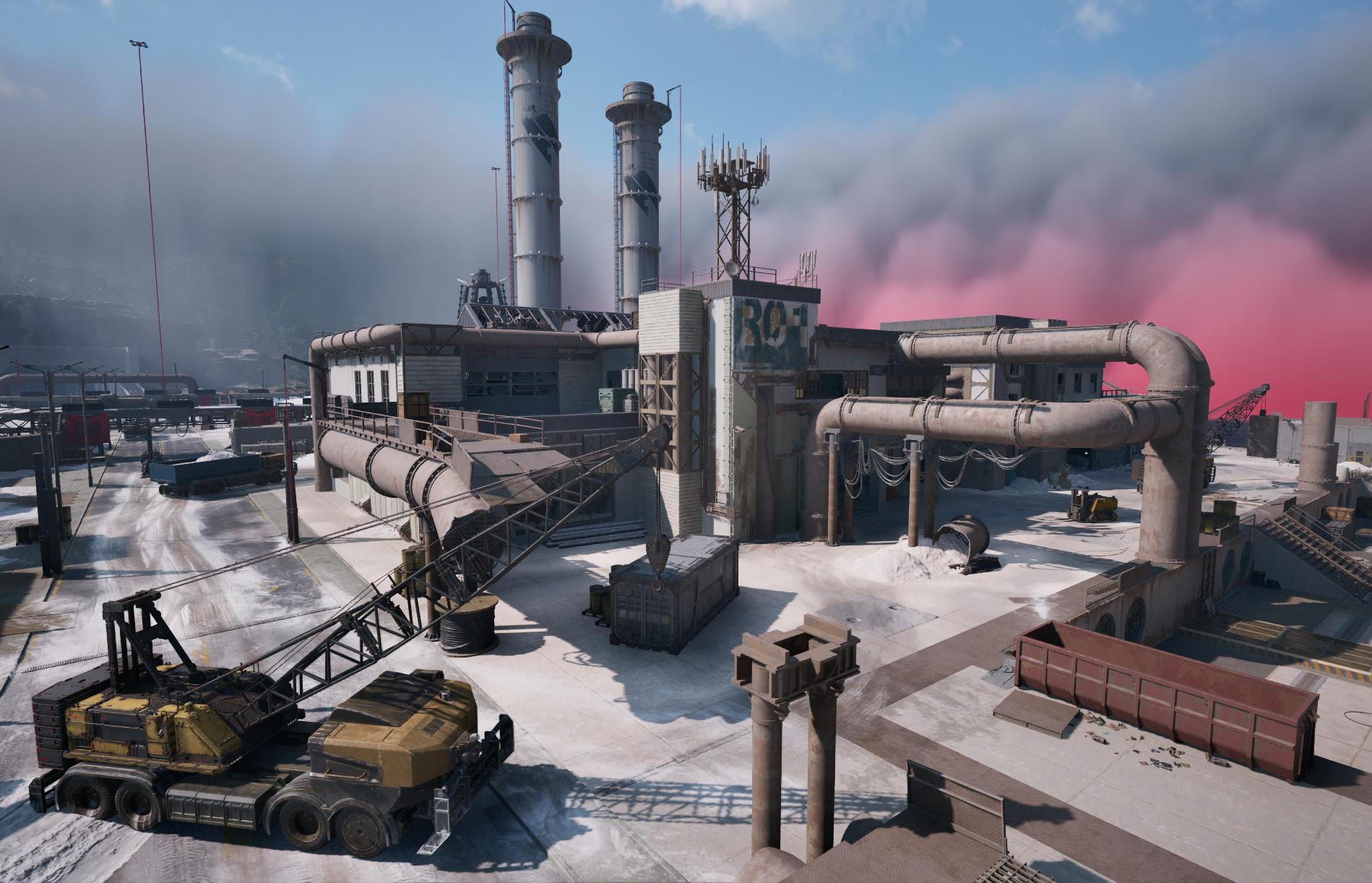
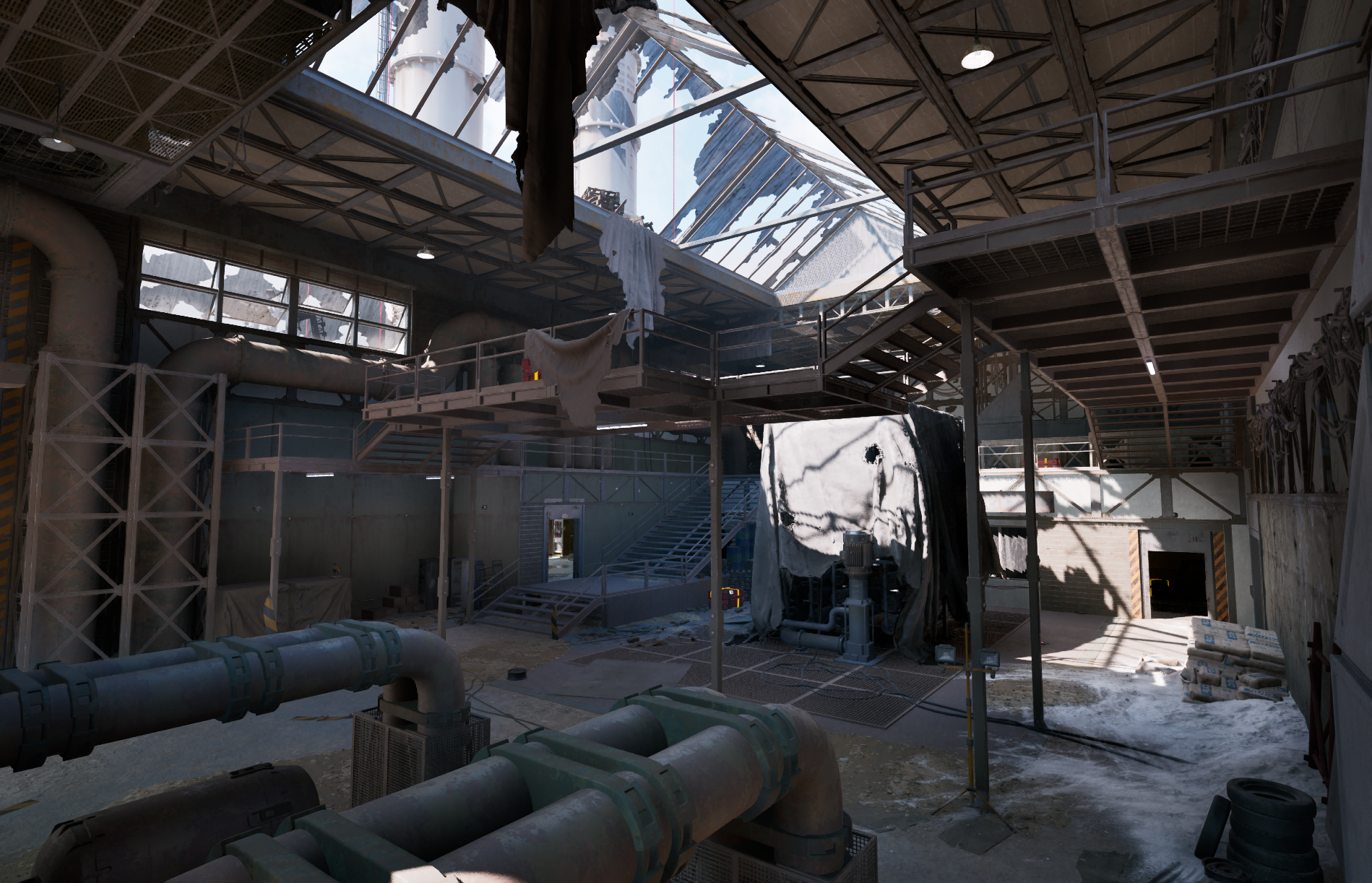
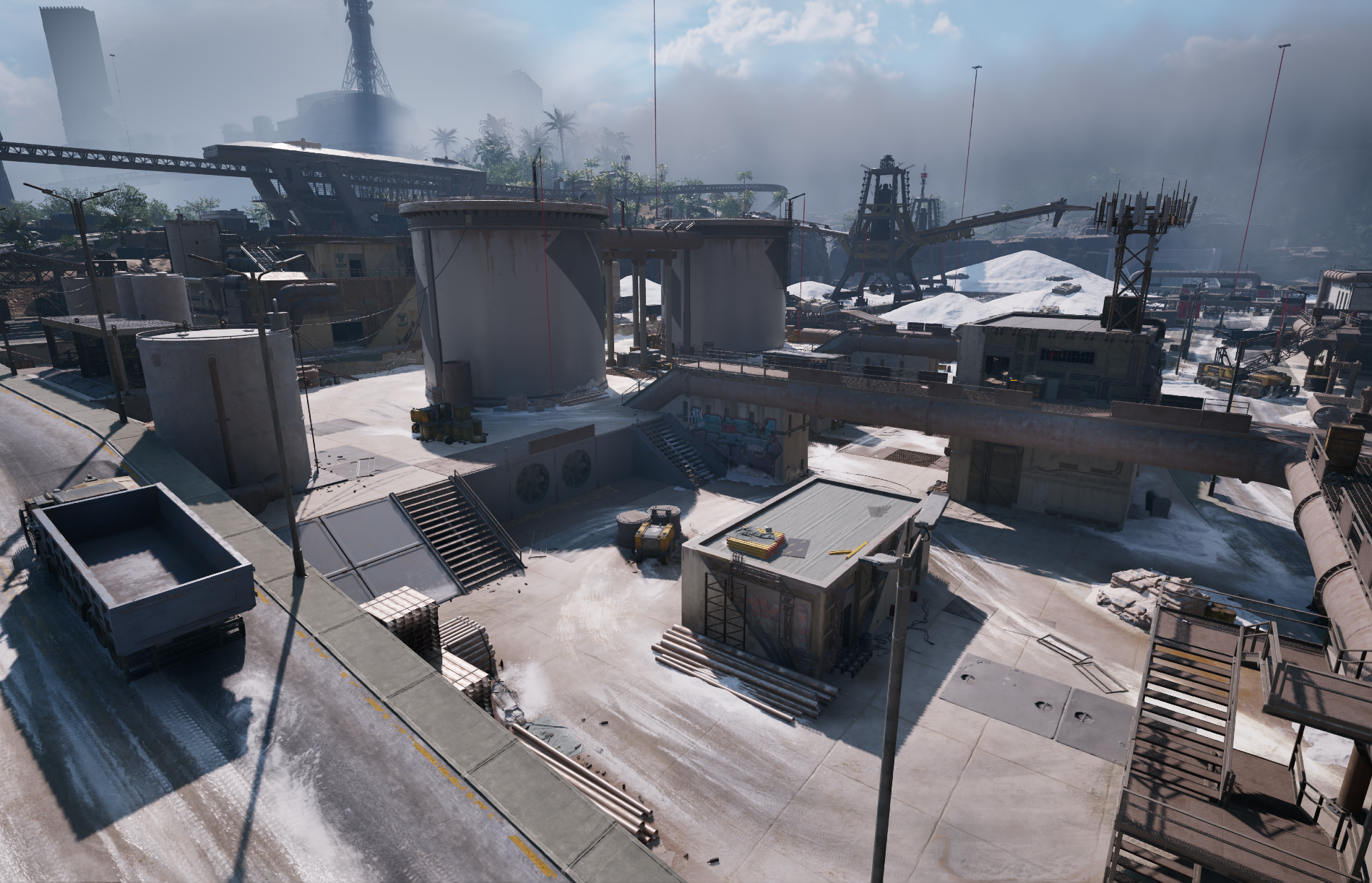
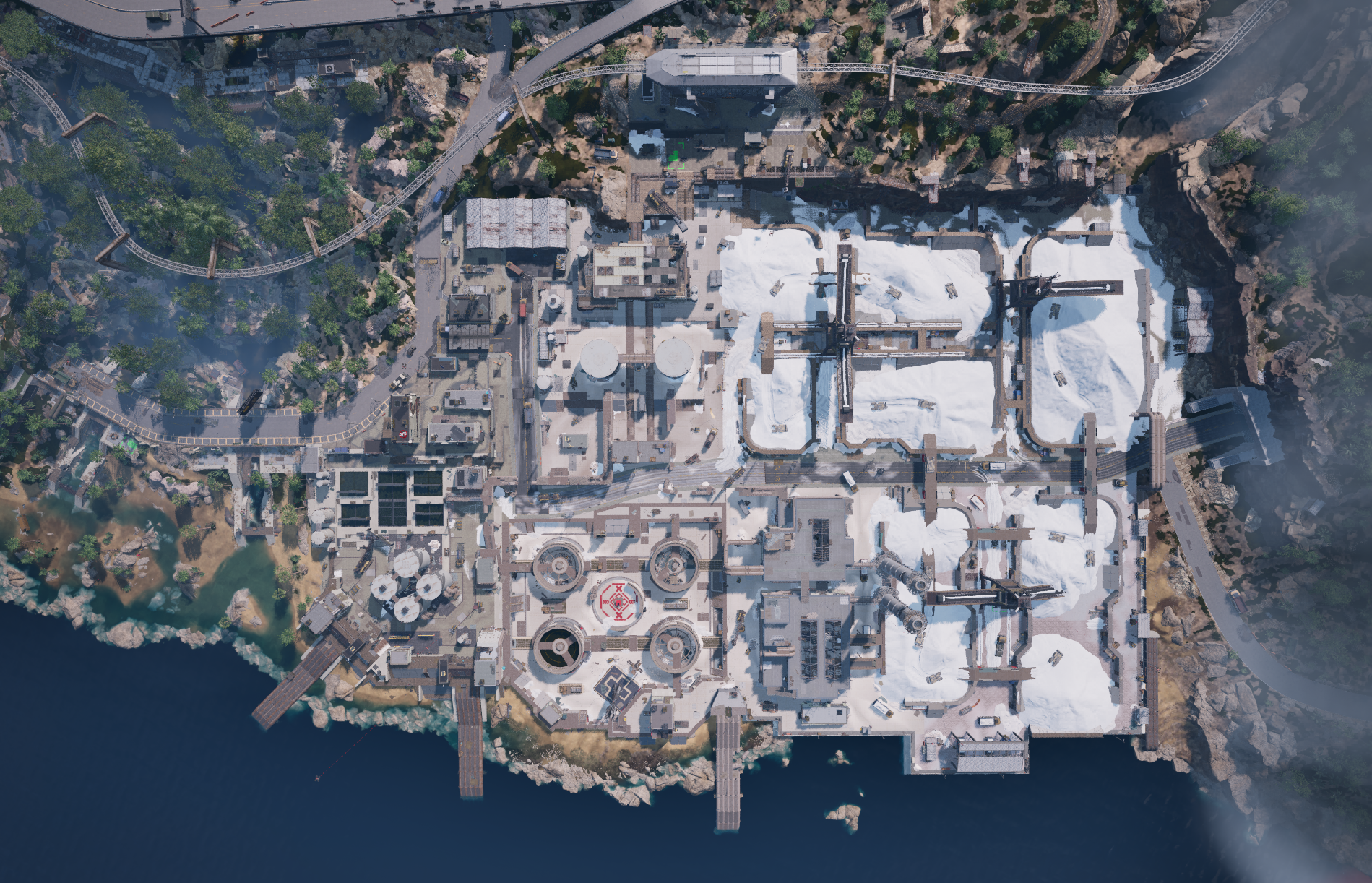
Credits: Design ownership of this location was transferred to me during the early whitebox stage. I worked on it until its release with a number of different LDs (shout-outs to Timo Bron, Barbod Nili, Laszlo Domjan, Jaume Sanz Sempere, Vitaliy Avdyeyev, Eugen Ionica and all the other departments).
‘Ocio’
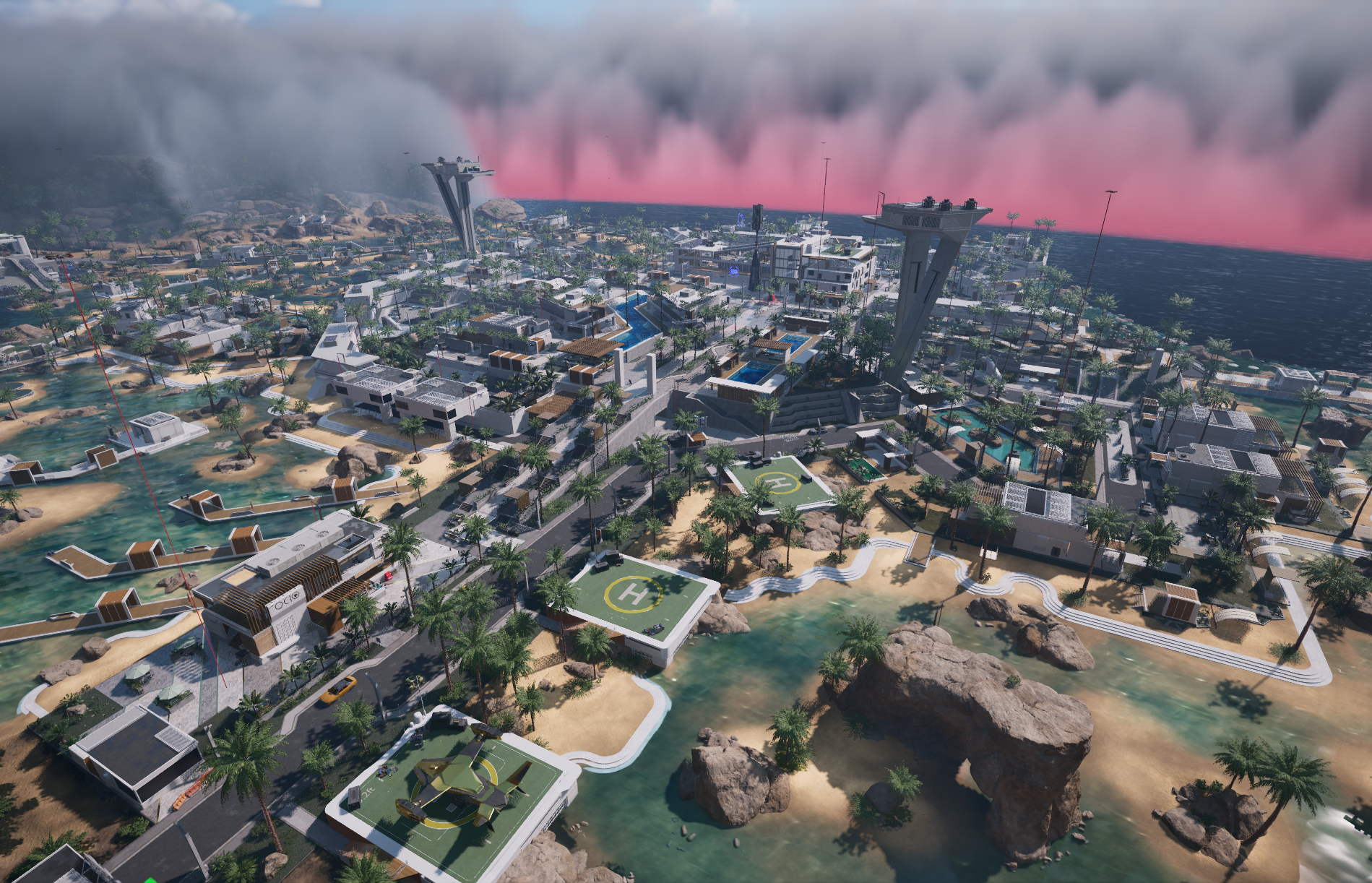
The theme of this location is a high-end holiday resort called ‘Ocio’ that had to be quickly evacuated by its affluent guests – a stark contrast to the rough neighbourhoods on Teardrop island.
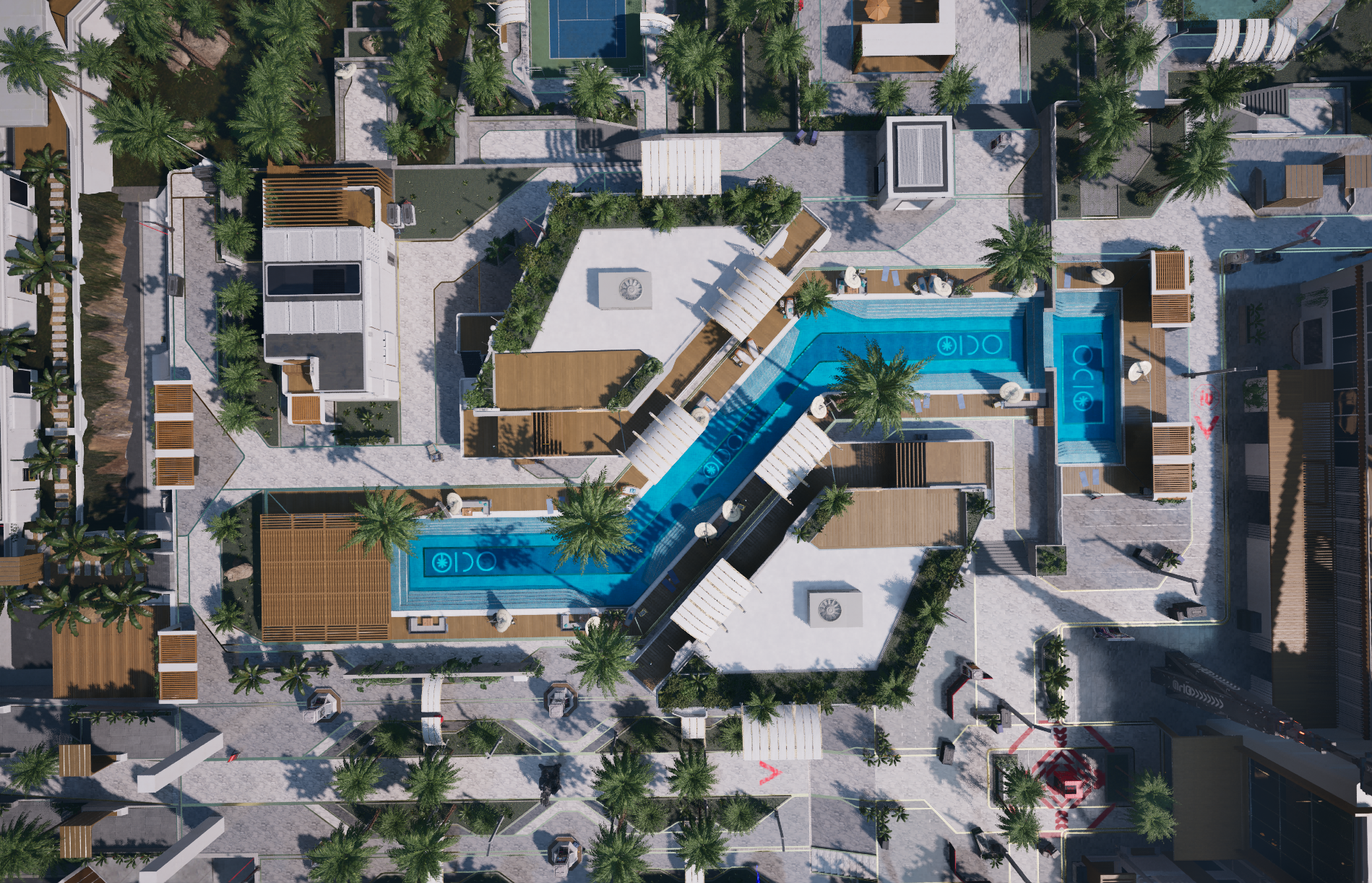
Pre-Production: I worked on Ocio mainly during the research, paper design and early whiteboxing phase. The main inspiration and brief was ‘an artificially built extension to Teardrop for those who can afford to visit it’ (think “The Palm” in Dubai). We pitched different iconic shapes for a layout. Ultimately, long lines and hard angles reminiscent of circuit boards to give it a cyberpunk look was the shape language that was established.
I transferred design ownership of the location to Barbod Nili to free up more time to act as interim Lead Level Designer. I was brought on again later as support during the final push to release. But the areas in the center of the island (the pool, the exterior of the hotel’s main building, the maintenance area) remain very close to my original whitebox designs.
Whitebox
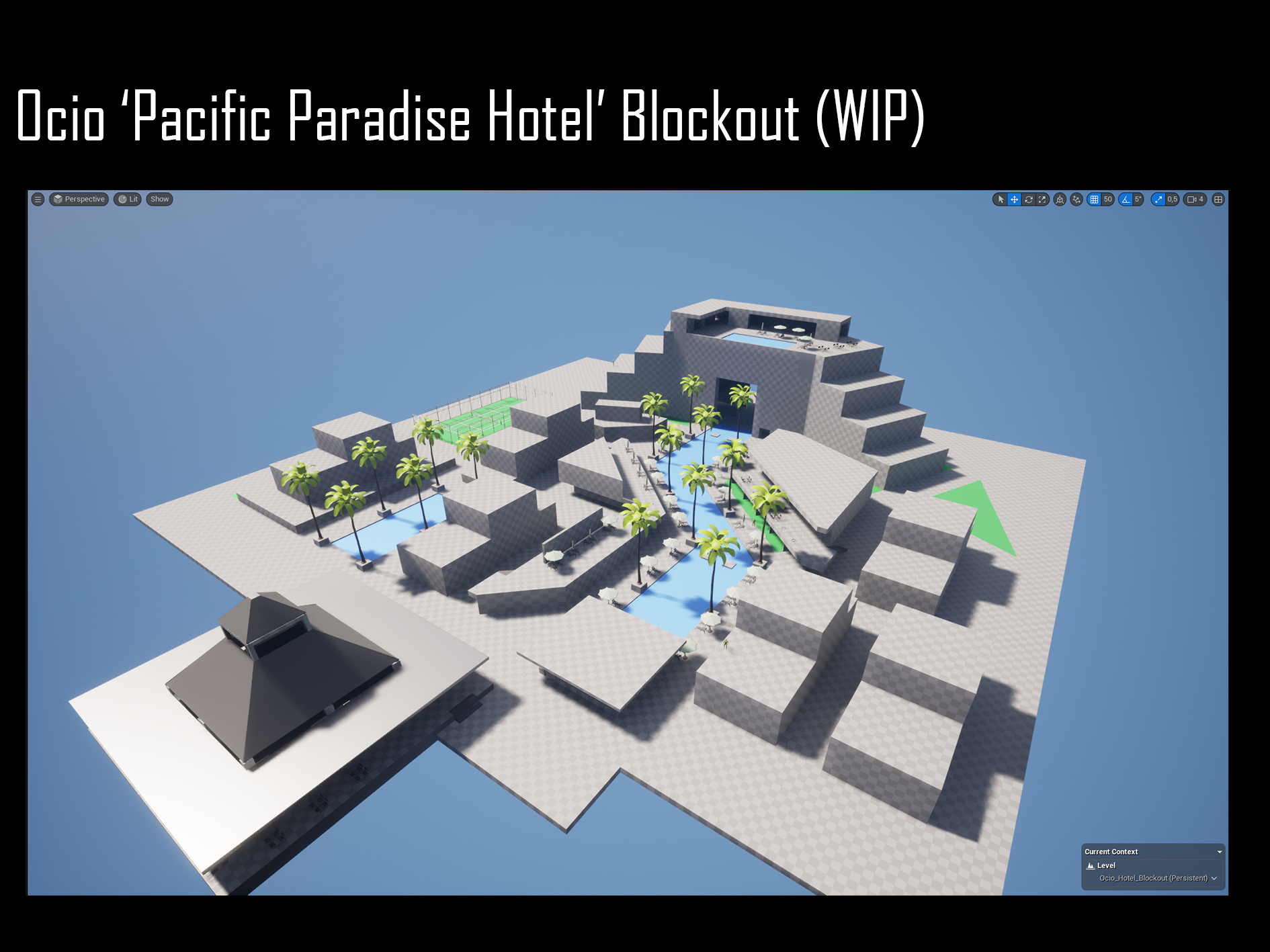
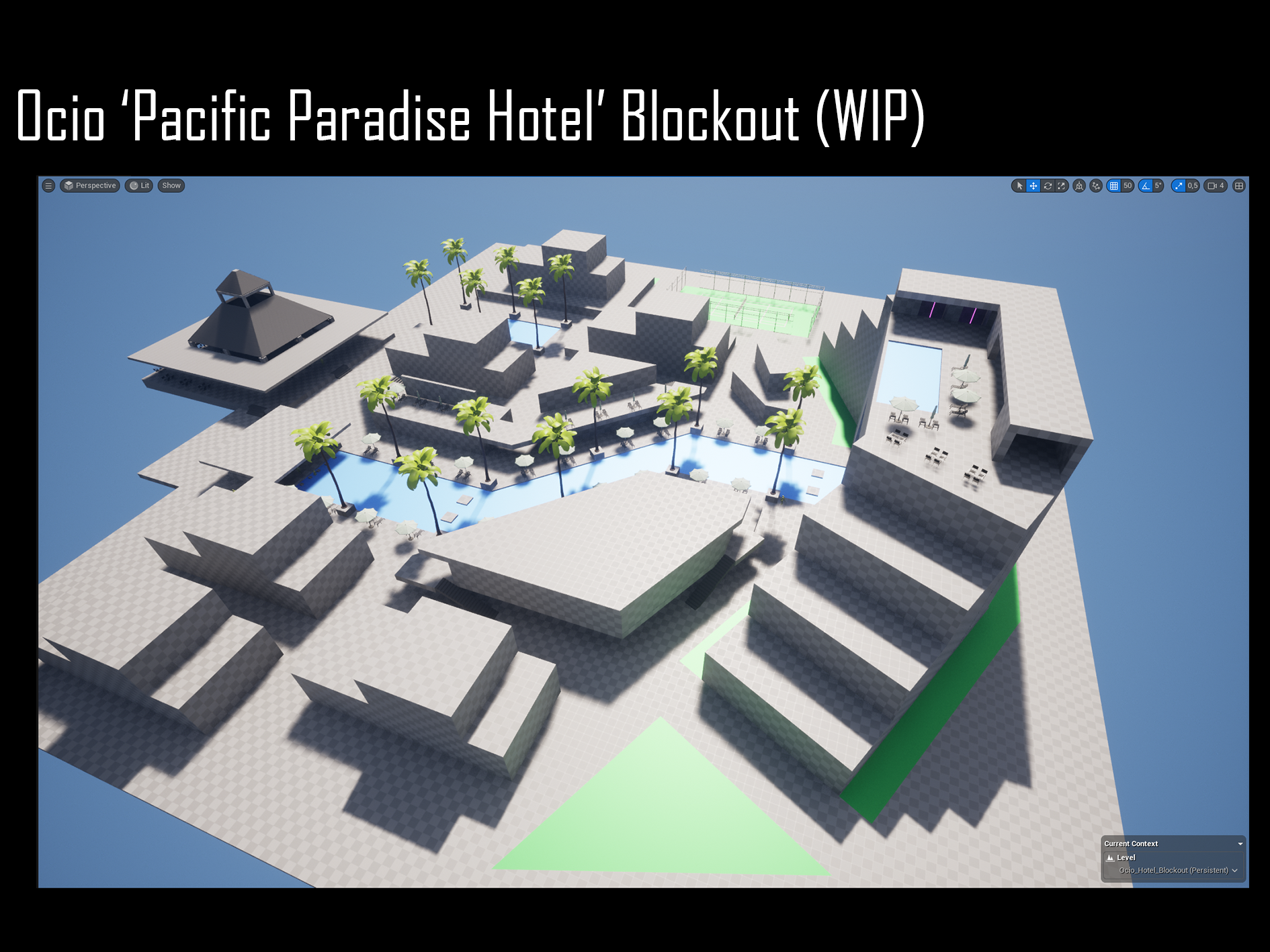
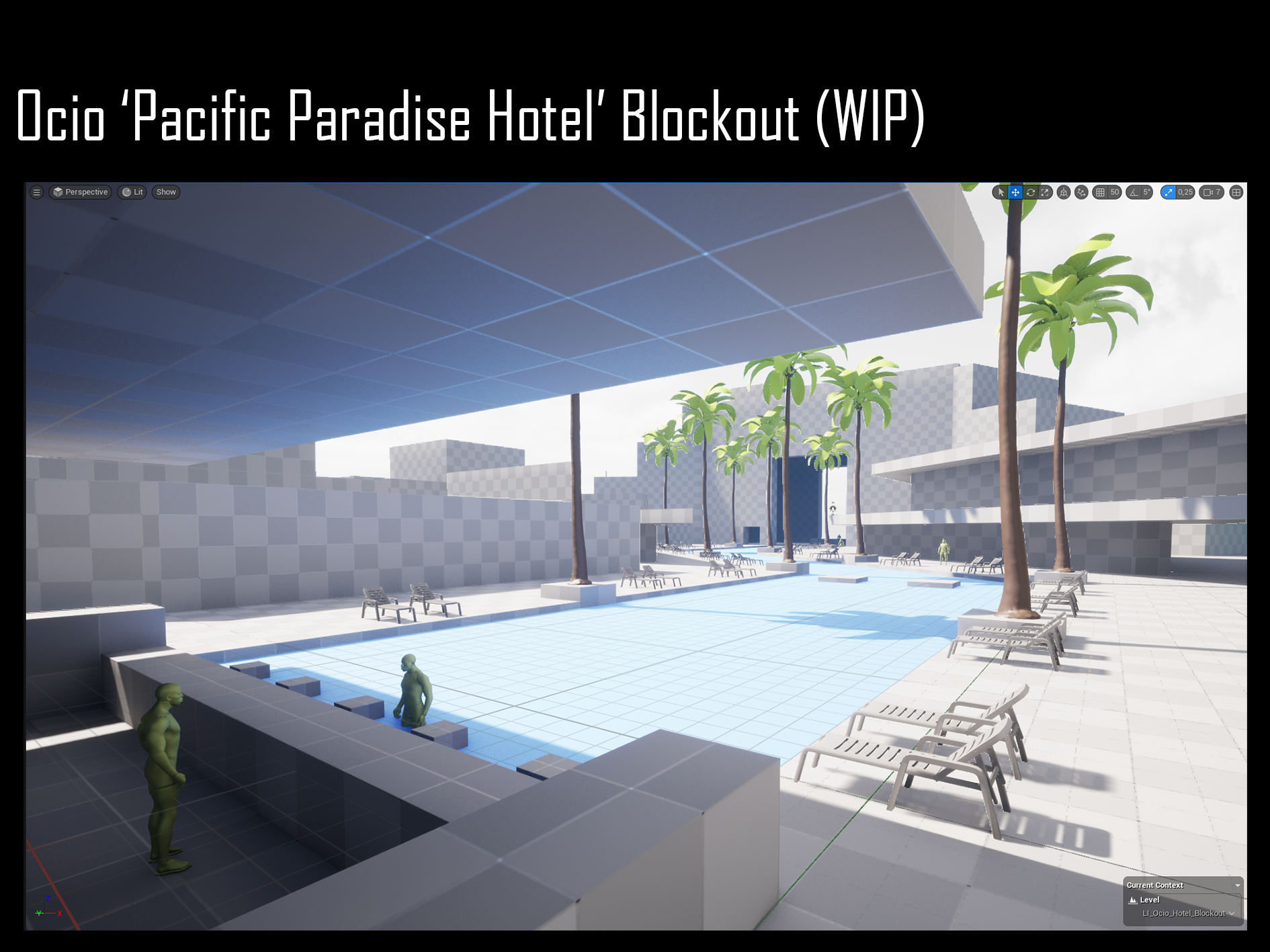
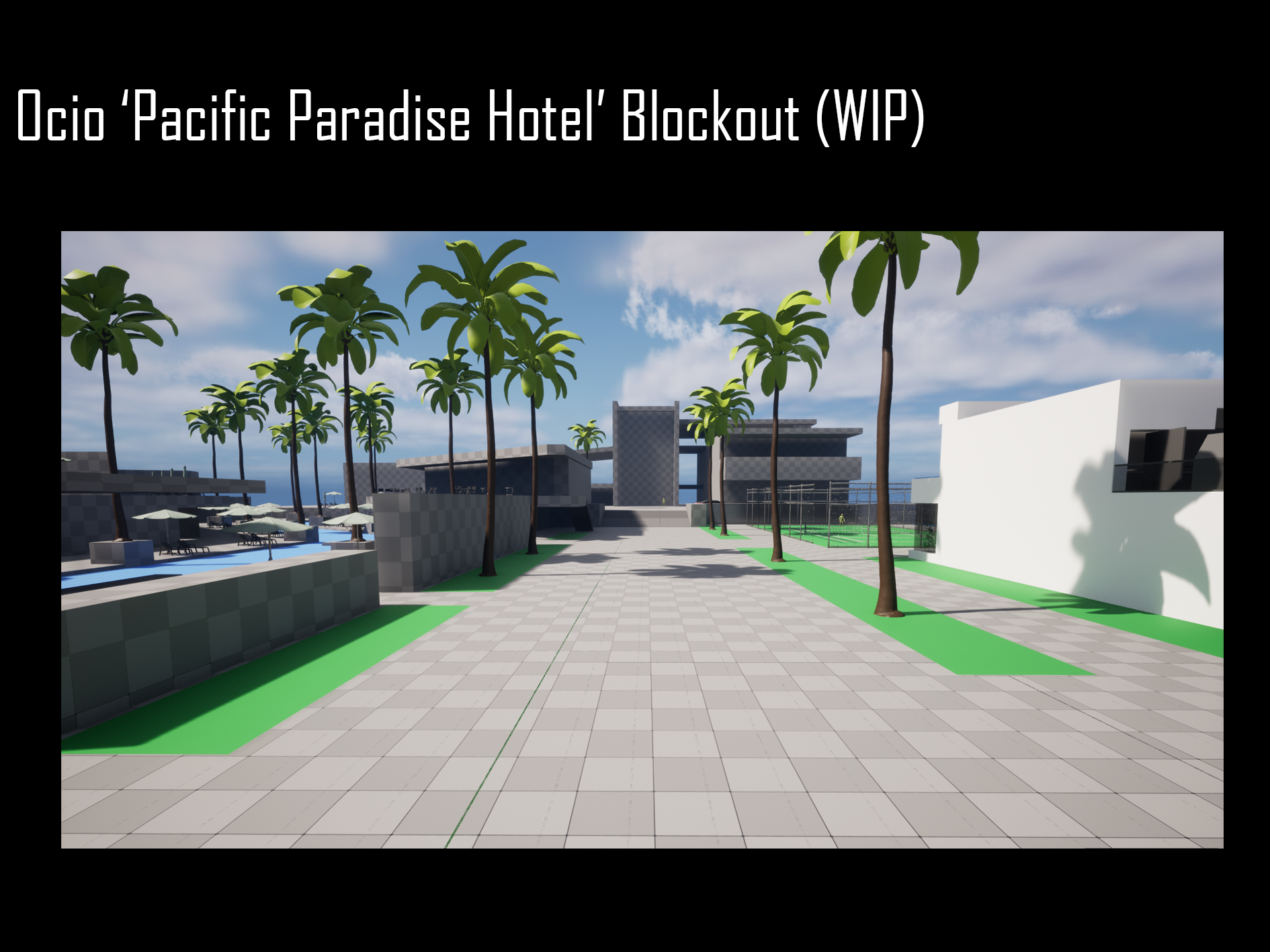
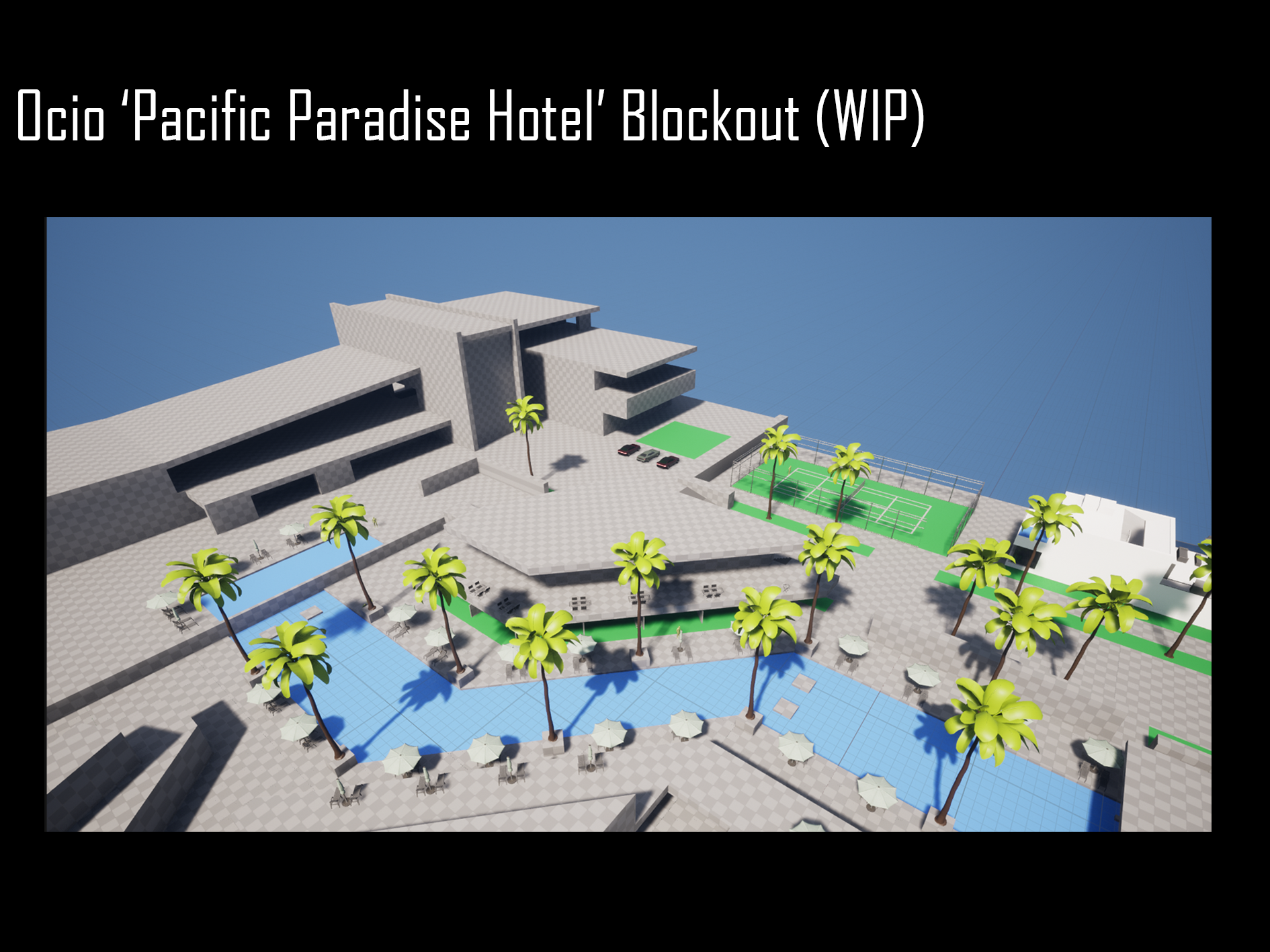
Landmark Building: The landmark of the location is the tall central hotel building that contains a reception, lobby, restaurants, a bar and hotel rooms. I took inspiration from iconic resorts on The Bahamas and in the UAE. Following a concept pass I adapted the whitebox of the building to bring both closer together.
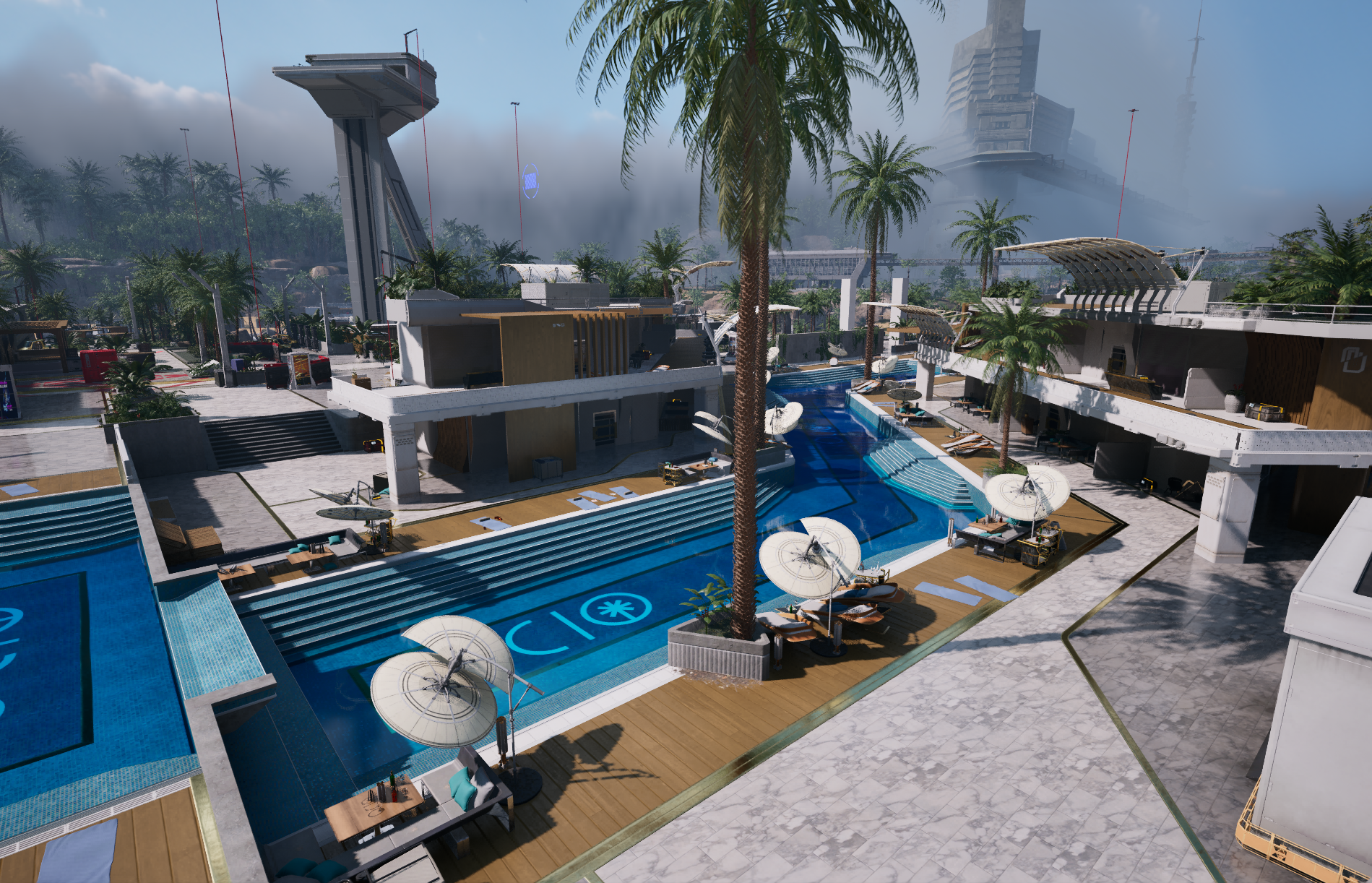
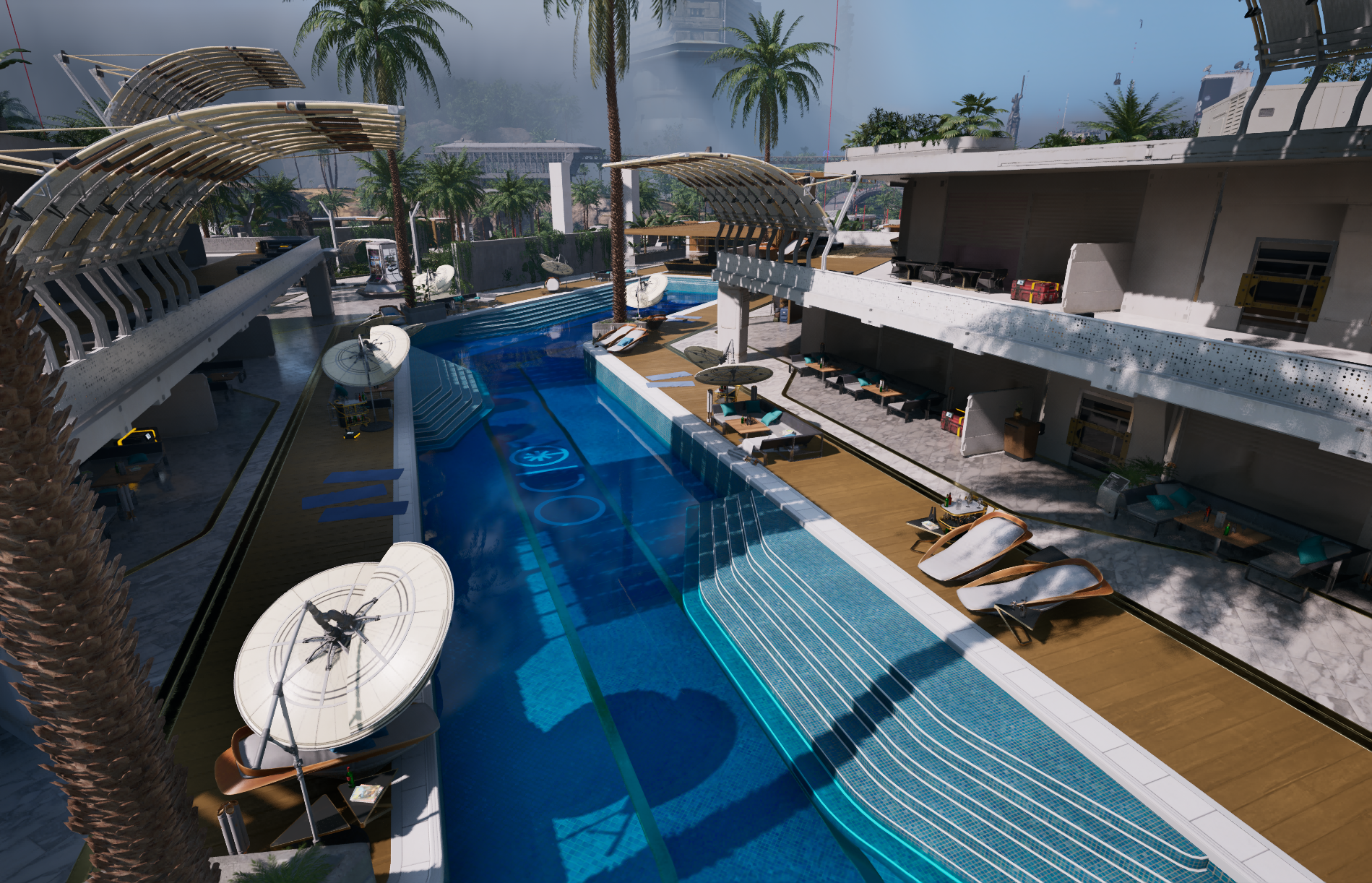
Central Pool Area: The pool area is based on a real-life hotel’s pool, but instead of going in a straight line, I introduced a zig-zag shape for less long sightlines and more cover. The two-level buildings on its side create interesting opportunities for firefights across the pool.
Other POIs are a pool bar, tennis courts (that were kept but moved to a different area of the location) and a storage area in the lower levels.
Final Result
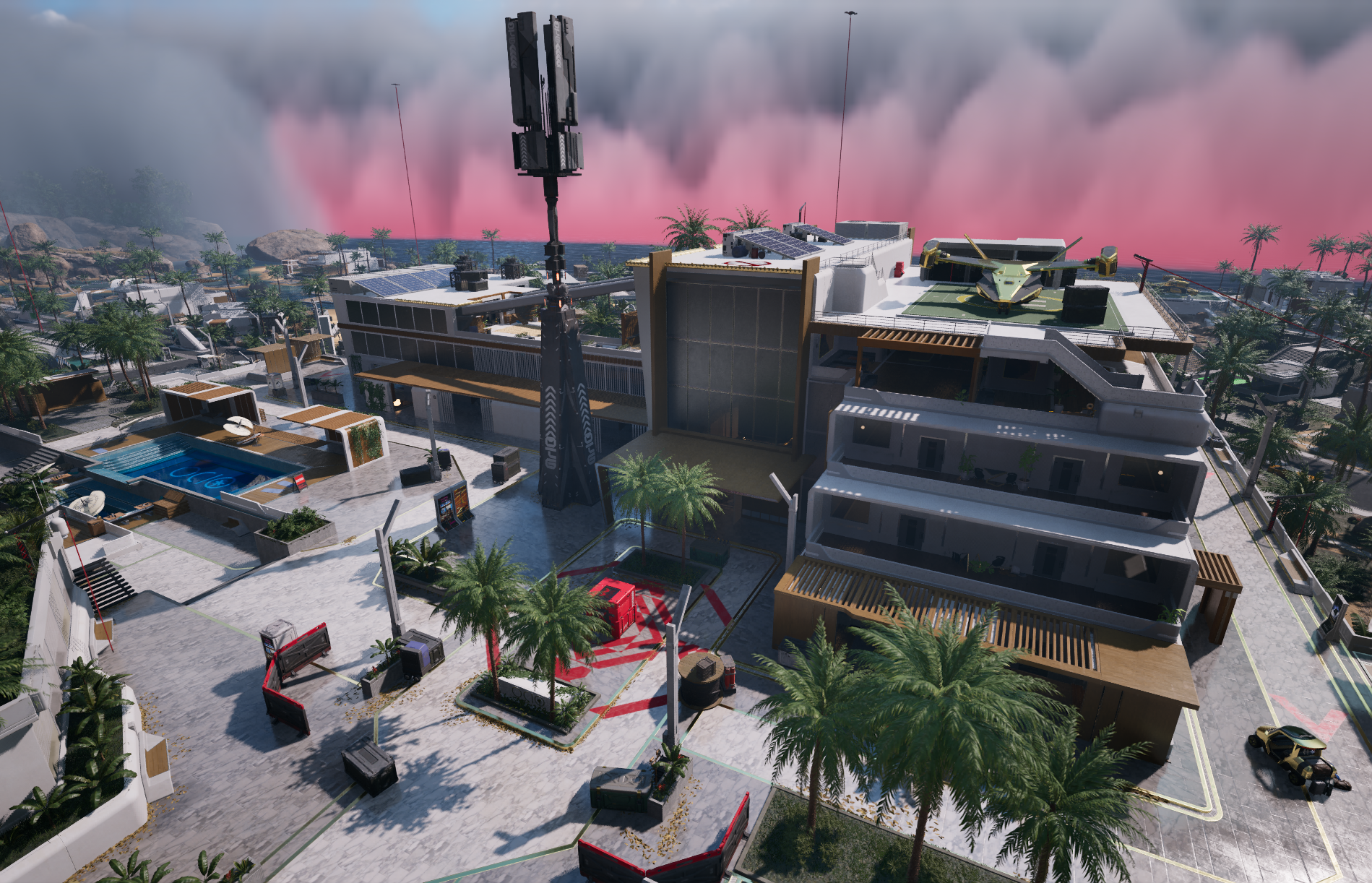
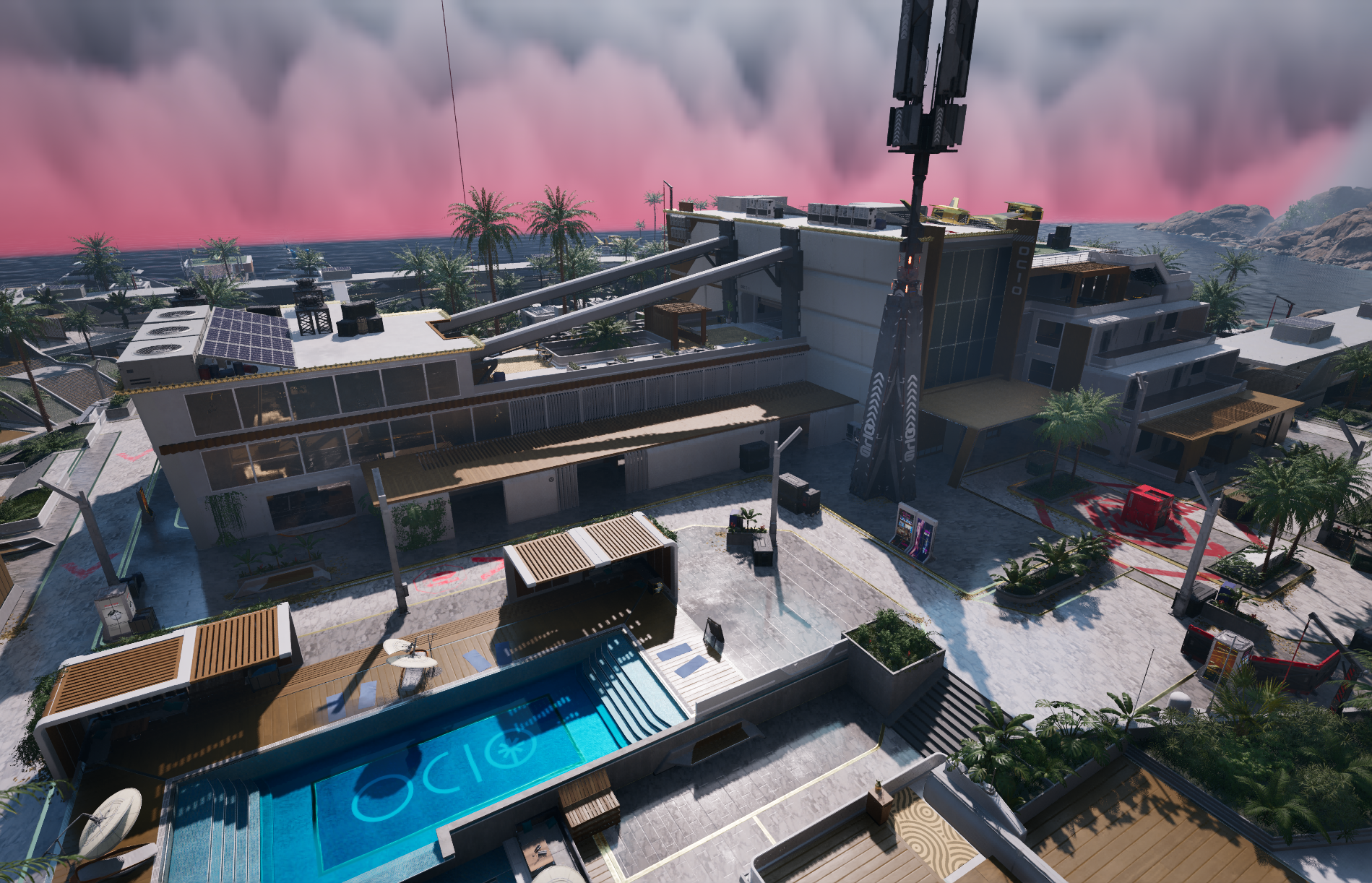
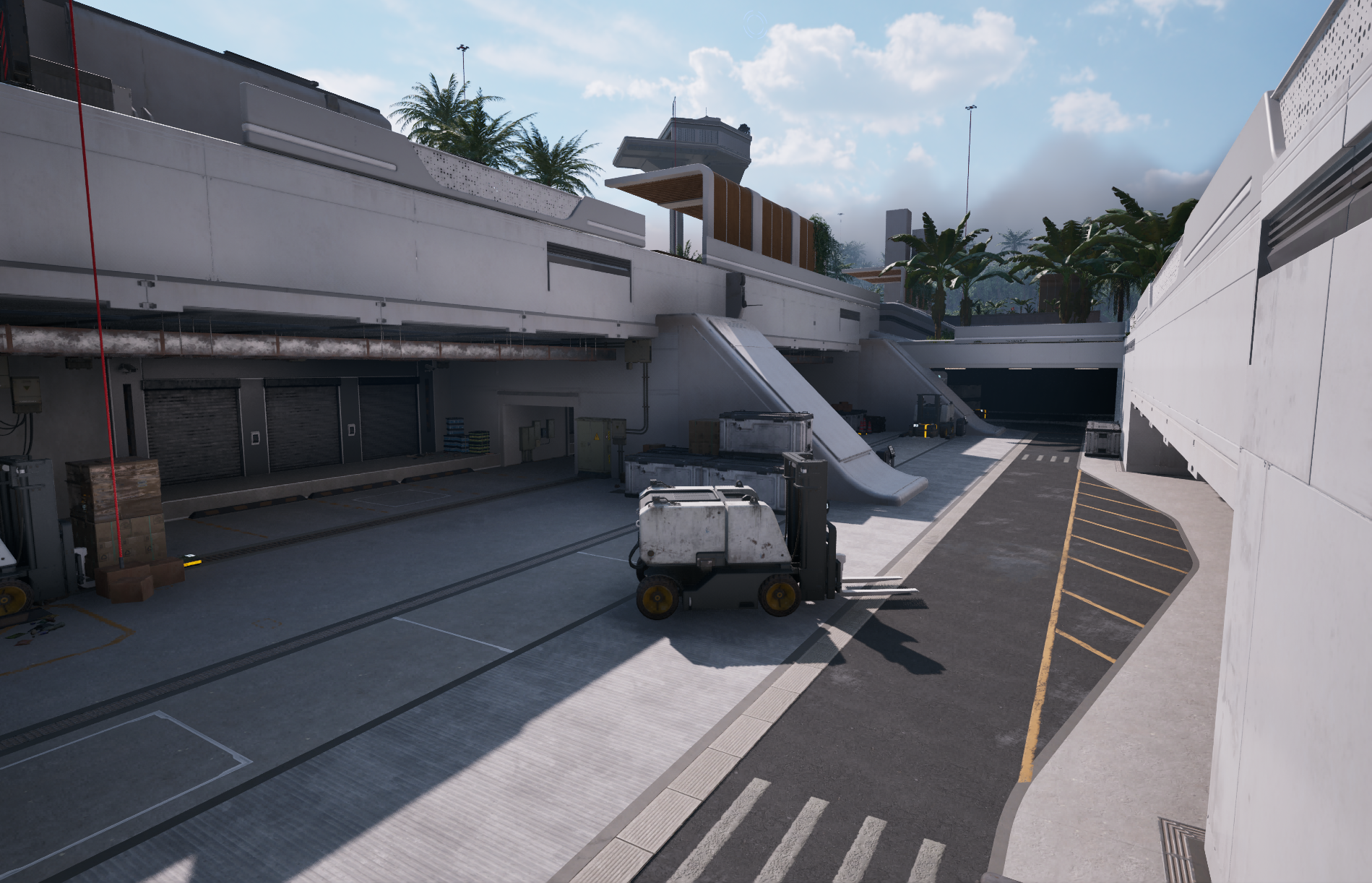
Regions:
‘Gamma’
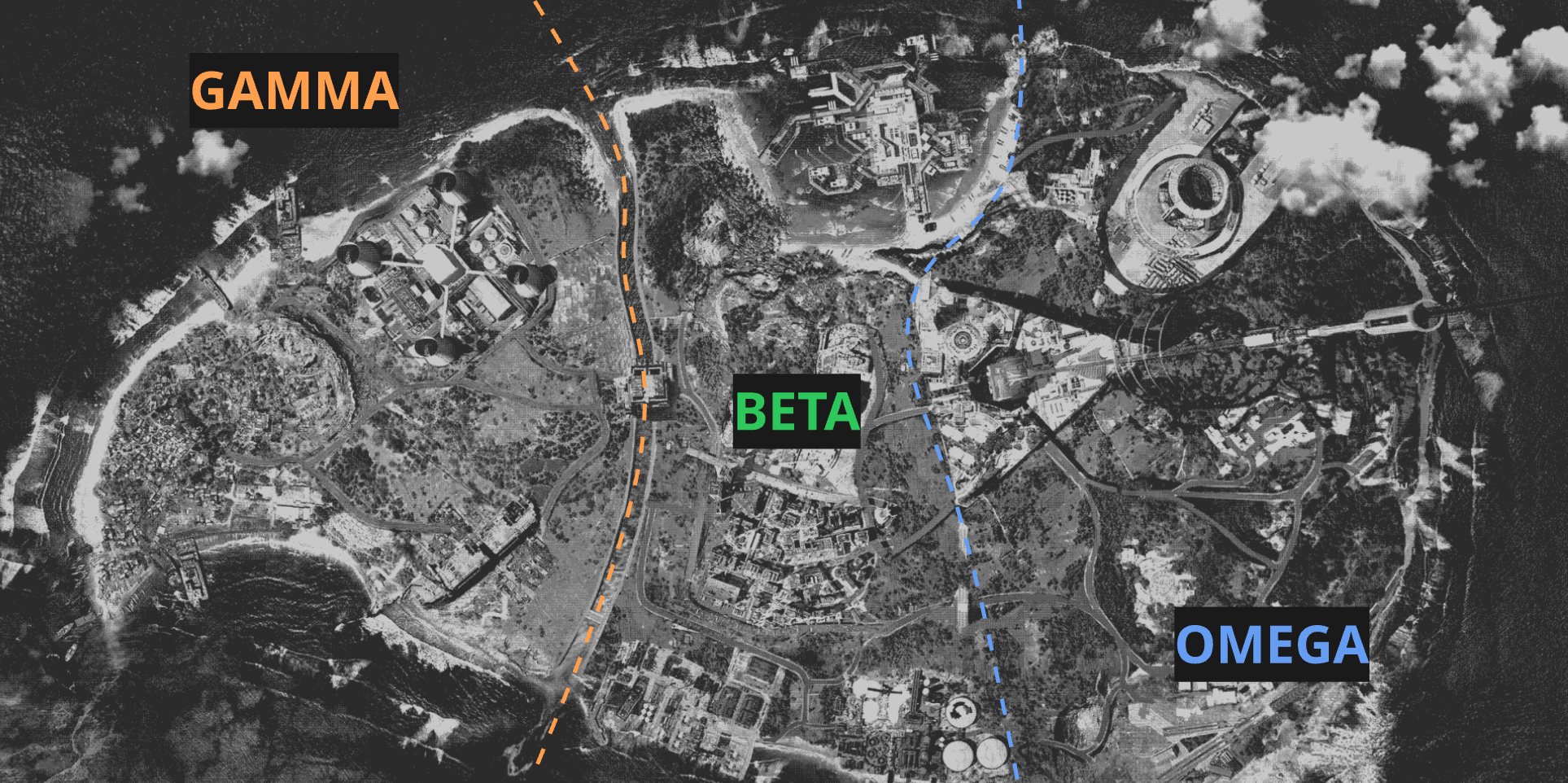
The world (or better: ‘island’) in Off The Grid is divided into three regions. Gamma, Beta and Omega. Beta is the region that is released and can be played in OTG today. Gamma is the region I had ownership of in designing. Part of that work included:
- Terrain elevation and biome design
- Placement of main locations in the region under consideration of terrain, distances to each other and landmark visibility
- Division into sub-regions and high-level design of their contents and attributes (points-of-interest, loot density, engagement ranges etc.)
- Infrastructure (main and secondary routes)
- Design ownership of one of the main locations in Gamma
Gamma (and Omega) region have not been released to this day and the details of my work are under NDA.
Buffer Zones:
‘Buffer zones’ is the term we use for the areas that are in-between the main locations of the map. They often consist of natural environments and open spaces. They are intended to let the locations ‘breathe’ but they shouldn’t be empty. Points-of-interests offer loot opportunities and lead players from one location to the next.
A few examples of this, which I have worked on, can be found in-between ‘Stork City’ and ‘Ocio’. A gas/charging station next to a highway and a vehicle workshop that allow players to loot items before they venture further into Stork City. Additionally, cabins for construction workers that serve as a stop-gap between Stork and Ocio.
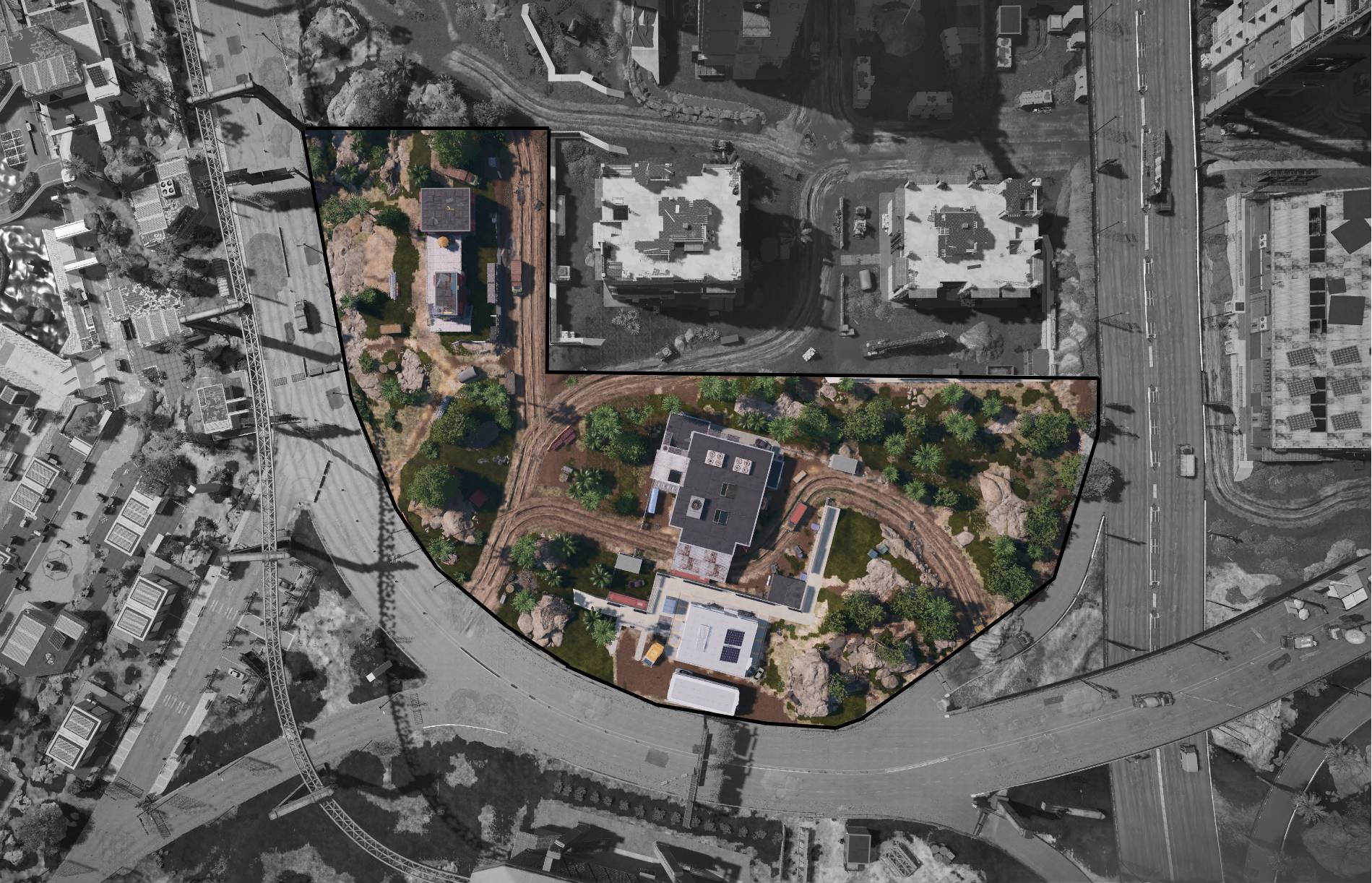
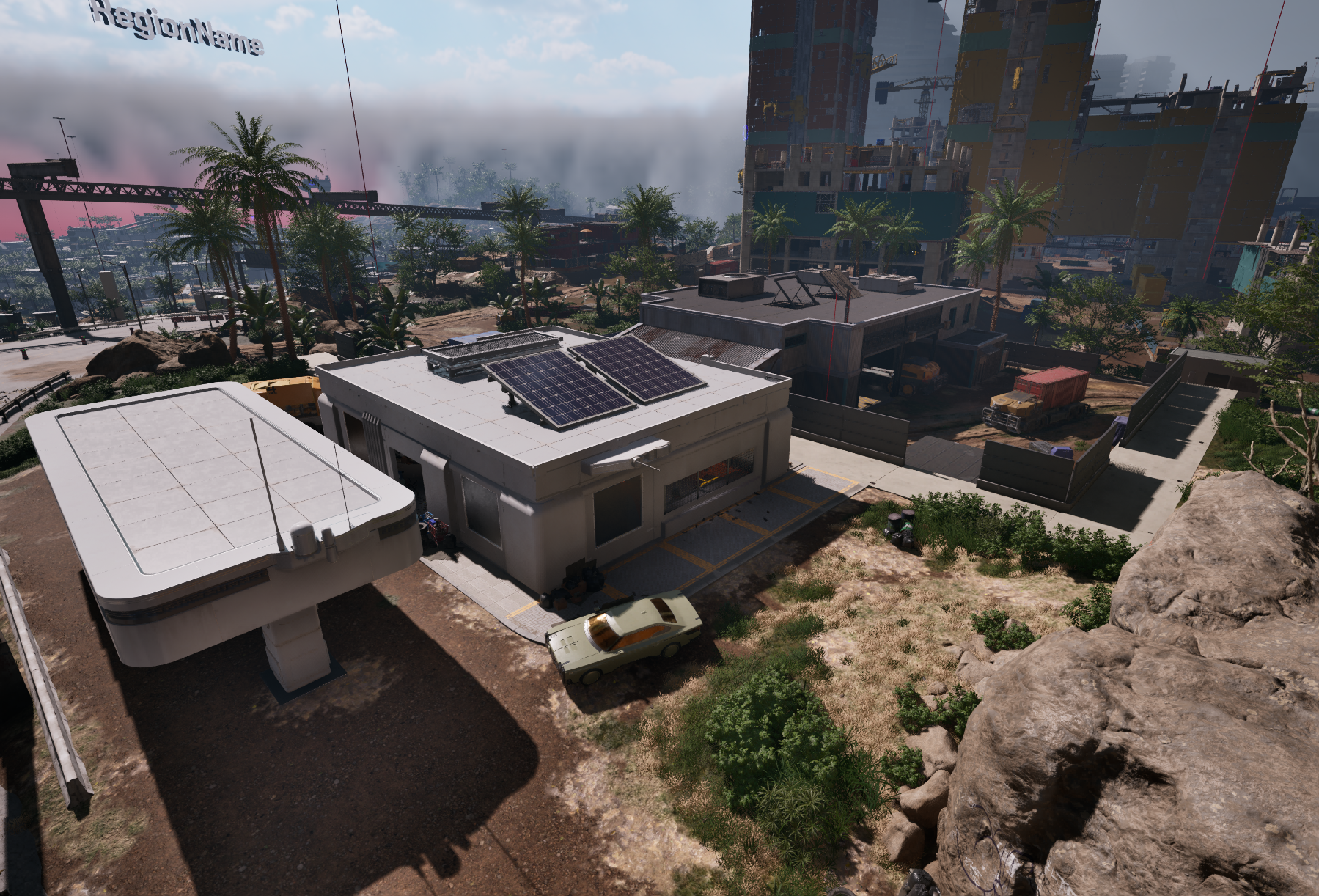
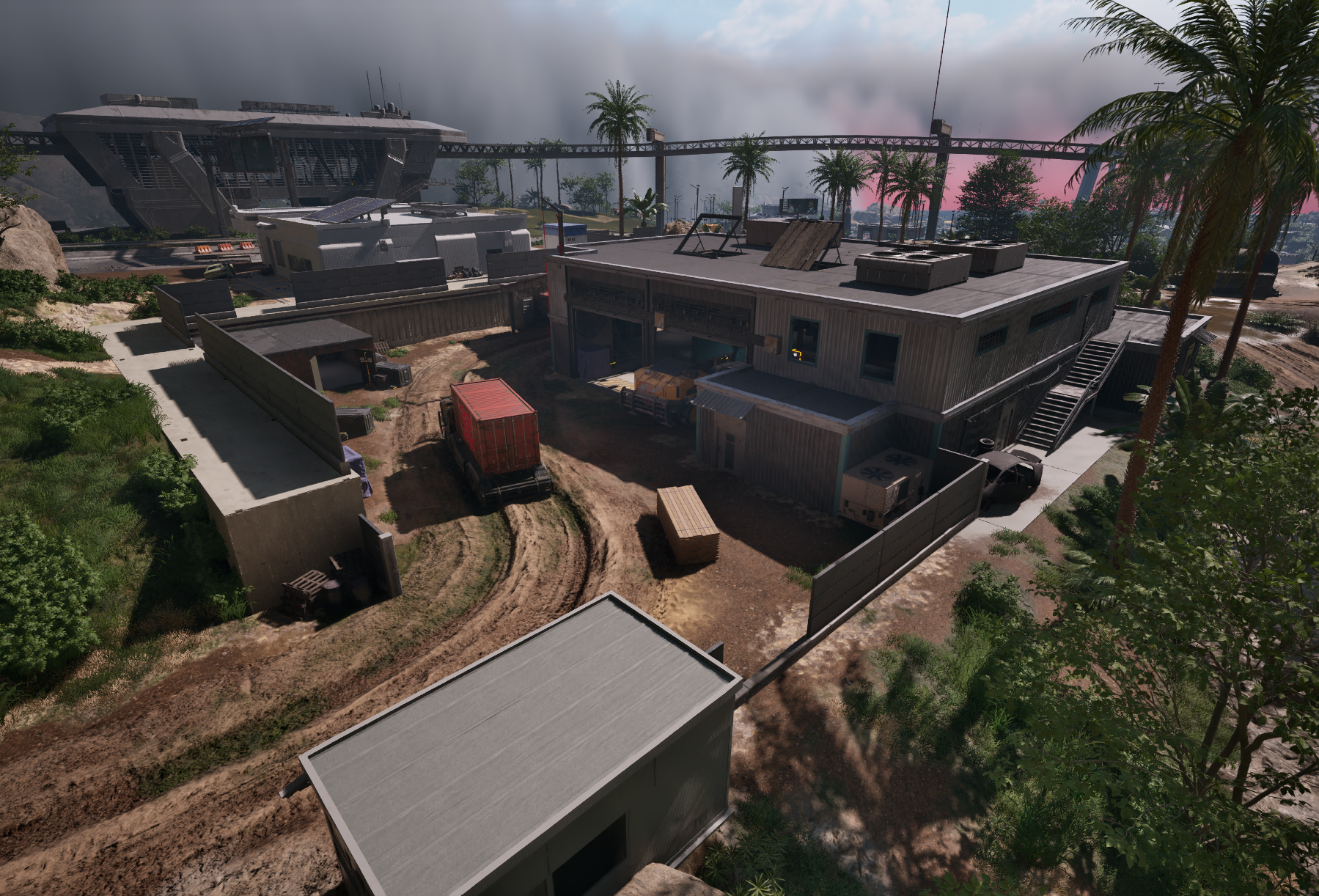
I designed the layout of the area and the whitebox of the vehicle repair shop. I used Joshua Ellis’ whitebox of the charging station and assembled it with final art assets. He finished the vehicle workshop for me. It was important to me that there is a nice flow between the POIs, enough loot opportunities and (soft and hard) cover when players are entering the city coming from the direction of the highway/monorail station.
More work samples available upon request.
Thanks for reading!